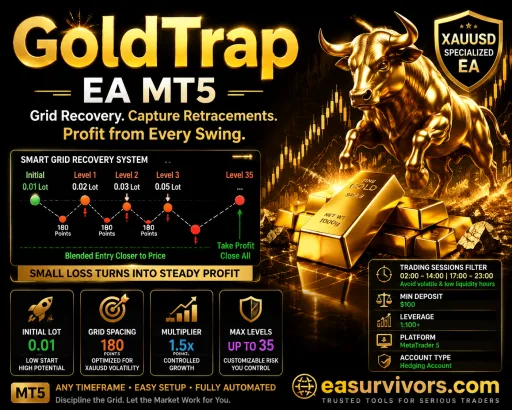
Approach to short-term gold trading
The product is aimed at traders who already understand that XAUUSD can trend hard and that any system which adds to a losing position is playing with fire. The vendor is explicit about the mechanics: up to six orders per cycle, placed at fixed point intervals. This is not a hidden martingale dressed up as something else. It is an averaging grid. If gold pushes fifty dollars without a meaningful pullback, every layer of the cycle is underwater and the equity stop has to do its job.
The built-in spread filter is worth paying attention to. On M1 and M5 charts, a wide spread during news or rollover erodes any edge a scalper might have. The EA refuses to open new entries when the spread exceeds a set threshold, which means it will simply sit out the worst moments instead of forcing a trade. That behaviour alone separates it from cheaper scalpers that fire continuously and bleed on costs.
How the cycle actually behaves
A cycle starts with one order and can grow to six. Each additional order is spaced by a fixed distance in points, which the trader adjusts in the set file. The idea is to average into a short-term retracement: price moves against the first entry, a second layer opens, and if a snap-back occurs, the whole basket trails out together.
The global trailing stop is only triggered after a predefined momentum expansion, so it does not hug price on every tick. That reduces premature exits but also means a strong reversal can give back open profit before the trail engages. The equity stop, by contrast, is hard: when the floating loss of the cycle reaches the configured drawdown level, everything is closed. That is the safety net, but it also means the account must withstand the full distance between the first layer and the worst-case price before the stop fires. On gold, that distance can be enormous in real money terms even with an apparently modest percentage.
Fixed lot sizing removes one variable. No multiplier grows the position on later layers, so the second order is the same size as the first. That is a deliberate choice: it limits the speed at which a losing cycle deepens, but it also means the recovery requires a larger retracement than a classic grid would need. The trade-off is real and the set file for a $500 account reflects it.
Installation and practical setup
The package contains a compiled .ex5 file and a single set file for a $500 balance on the M1 chart. The EA runs only on MetaTrader 5, so MT4 users cannot use it even with an emulator. The license is NoDLL, meaning no external dynamic library calls, which reduces the likelihood of security warnings from Windows or the terminal itself.
The developer states the EA works on any account type and any leverage. That is technically true, but not practically useful. A low-spread ECN-style account is the sensible home for this kind of system. Commission costs matter on M1 gold scalping. A standard account with a $2.50 round-turn spread plus slippage will eat a large fraction of each intended profit. The set file is named after one particular broker, but that is merely the environment the developer used for optimisation, not a recommendation to use that broker specifically.
Set-file parameters are worth going through line by line before live trading. The order spacing, the maximum number of layers, the trailing activation threshold and the equity stop percentage all work together. Changing one without the others changes the character of the system. On a $500 deposit, a six-order cycle with default spacing can comfortably use the entire free margin if gold moves the wrong way; a trader who does not understand the margin layout could face a margin call before the equity stop is reached.
What a buyer should expect
This is not a plug-and-play profit machine. The vendor's material is unusually restrained: no profit claims, no return percentages, no screenshots of a blown-up account. That is a point in its favour. The system sells its structure, not its results.
The realistic expectation is that the EA will generate many small winning cycles punctuated by occasional large losses. The spread filter and fixed lots keep the small wins from being eaten away entirely, and the equity stop keeps a single bad sequence from wiping the account in one blow. But no configuration can turn a $500 gold account into something that prints steady daily income. The averaging structure means risk is concentrated in the tail: the account is fine until the day gold trends without a bounce, and then it is not.
Forward testing on a demo account for several weeks is the minimum sensible step. The M1 chart behaves differently during Asian, London and New York sessions, and the spread filter will therefore block different proportions of potential entries. Watching the EA skip trades because the spread is too wide teaches a trader more about its real behaviour than any backtest.
Why the set file matters more than the EA
The .ex5 is a fixed engine, but the set file is where the risk profile is decided. A trader who downloads the package and runs the provided $500 set is accepting a specific distance between orders and a specific equity stop percentage. Anyone planning to run larger capital should not simply scale up lot size; the whole cycle structure should be re-evaluated for the larger account. The developer's set file is a starting point, not a golden ratio.