What the system actually does
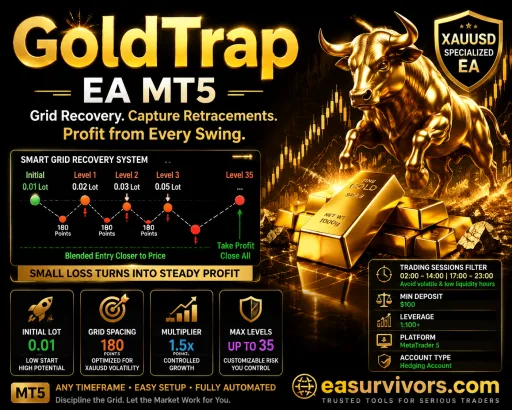
This expert advisor runs a semi-aggressive grid strategy on four major pairs. When price moves against an open position, the EA opens additional trades at fixed intervals. Each new level uses a lot multiplier of 1.5, so position size grows progressively rather than at a fixed rate. The basket is closed in full once the combined profit across all open trades reaches the take-profit threshold, which is set at 40 points by default. The maximum number of levels in a single grid sequence is 20.
The vendor describes this as a controlled alternative to classic martingale. That framing deserves scrutiny: the multiplier is lower than a full double-up, but the total exposure still rises when the market trends in one direction. The 20-trade cap is effectively a drawdown circuit breaker, not a guarantee of limited loss. A trader who runs this on a $100 account should understand that a prolonged move against the grid can still consume the entire balance.
Default parameters and how they interact
- PipStep: 50 points. This controls the distance between grid levels. On M5 and M15, a 50-point gap means new positions can open relatively quickly in volatile conditions.
- LotMultiplier: 1.5. Each subsequent position is 50% larger than the previous one. After five levels, the sixth trade is more than seven times the initial lot size.
- TakeProfit: 40 points. The grid closes as a basket when this profit target is reached. Because average entry price improves as the grid expands, a smaller retracement can trigger closure.
- MaxTrades: 20. This is the hard limit on open positions per symbol. Once hit, no new grid levels are added, leaving the basket to either close at take-profit or run to a manual stop.
There is no hard stop-loss mentioned in the supplied documentation. That is a material point, not a minor detail. Without a fixed stop, the 20-trade cap is the only built-in protection against an extended one-way move. Traders running this on a live account should decide in advance whether to attach a manual stop or accept that the grid can remain open for a long time.
Operating the EA on a real chart
Installation is straightforward: attach the single .ex4 file to an M5 or M15 chart on one of the four supported pairs. The vendor states that any timeframes can be used, but the supplied set files are configured for M5. Using the provided presets is advisable for first-time users, because the internal parameters interact in ways that are not obvious from a static reading of the Grid.
The download package includes two set files: one labelled EURUSD 100$ M5 and another labelled GBPUSD 500$ M5. These are not fixed requirements, but starting points. A trader using a $100 account on EURUSD should load the corresponding preset rather than simply attaching the EA with default values. The preset adjusts the initial lot size to keep margin usage within reasonable bounds for that balance.
The vendor sells the product as NoDLL / Unlimited. That means the advisor does not rely on an external dynamic link library; the logic is self-contained in the .ex4 file. The licence is not tied to a single account number, so the same purchase can be used across multiple MT4 installations or account types. Source code is not included.
The backtest numbers should be read cautiously
The marketing copy includes two backtest results. One claims a profit of $3,199.66 from a $500 deposit on GBPUSD with a maximum drawdown of 32.99%. The other shows $4,301.64 from a $100 deposit on EURUSD with a maximum drawdown of 53.68% and a win rate around 71%. The vendor presents these as evidence of long-term performance.
Any grid system that closes baskets at a profit will naturally show a high percentage of winning closes. That does not mean the equity curve is smooth. The drawdown figures themselves are substantial: a 53% drawdown on a $100 account means the balance dips to roughly $47 before recovering. A trader who funds an account with exactly $100 has very little room for that kind of excursion. The claimed profits are taken from backtested periods that may or may not reflect current spread, slippage and swap costs. The developer reports these results; they should not be assumed to replicate on a live server.
Where the real risk sits
Grid strategies share a common failure mode: a strong trend that never retraces far enough to trigger the basket take-profit. The 50-point pip step means new positions open frequently during such a trend. With a 1.5 multiplier, the notional exposure grows quickly. By the tenth level, the position size is roughly 38 times the starting lot. The 20-trade cap slows this process but does not stop it. If the move continues far enough, the floating loss exceeds the account equity and a margin call forces liquidation before the grid completes.
This is not an argument against the EA. It is the core question every buyer should answer before placing it on a live account: what happens to this system in a trending market that last 300-500 points without a meaningful pullback? The vendor does not claim the EA avoids such conditions. It relies on the grid to average down and the basket to close when price eventually returns. The size of the position at that point determines whether the recovery is sustainable.
Practical considerations for a new user
The system is aimed at traders with small accounts, based on the $100 minimum deposit and conservative-sounding starting lots. That positioning is honest in one respect: grid strategies can be run on small balances because they do not require a large stop-loss in points. But the effective risk is not defined by the deposit size; it is defined by the maximum grid depth and the lot progression. A $100 account that reaches 20 grid levels on EURUSD is likely holding more than a full standard lot in total, which is far beyond what most brokers would consider reasonable leverage for that balance.
Traders interested in this product should test it on a demo account under the same conditions they intend to trade live. Run it through a period that includes a sharp one-way move, not just ranging conditions. Watch how quickly the grid expands and how much margin is consumed. That single observation says more about suitability than any backtest report.