A tightly focused XAUUSD engine for MetaTrader 5
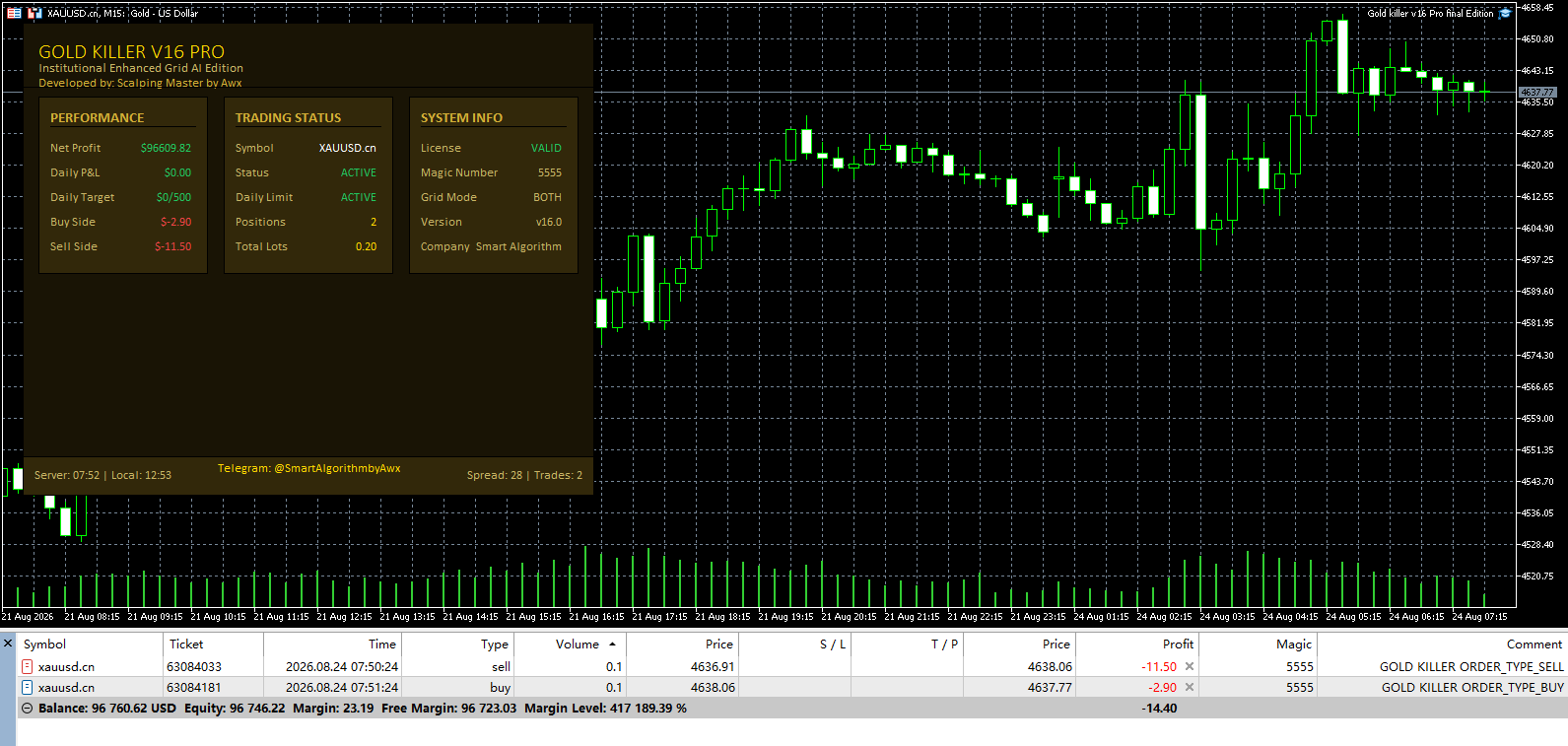
Gold Killer Pro EA MT5 is a single-pair expert advisor. It trades nothing except spot gold on MetaTrader 5, which immediately narrows the audience: traders who already watch XAUUSD and want a rules-based alternative to manual execution. The core logic blends a scalping entry model with a micro-grid recovery layer. That combination deserves scrutiny, because grid components can accumulate positions quickly when gold trends hard in one direction.
The product ships as a compiled .ex5 file only. No source code is included, and no DLL calls are required. That tends to matter for users running the EA on rented VPS machines or on machines with strict execution policies. A single set file is provided, aimed at a $1,000 balance. The vendor lists a minimum deposit of $100, with the suggestion that smaller amounts be run on a cent account to preserve position sizing granularity.
Timeframe is specified as any. That is unusual for a grid-based scalper, but it points to the EA's use of internal candle processing rather than a specific chart period for signal generation. Traders may still want to test on several timeframes before trusting the vendor's claim, since the entry frequency and grid exposure can vary sharply from M1 to H1.
How the micro-grid and trailing actually work
The advertised strategy has three moving parts. First, a volatility-triggered entry logic that looks for short-term gold structure. Second, a grid recovery model that opens additional trades as price moves against the initial position, averaging the entry and targeting a combined profit close. Third, a dynamic trailing mechanism that adjusts exit levels as a cycle moves into profit.
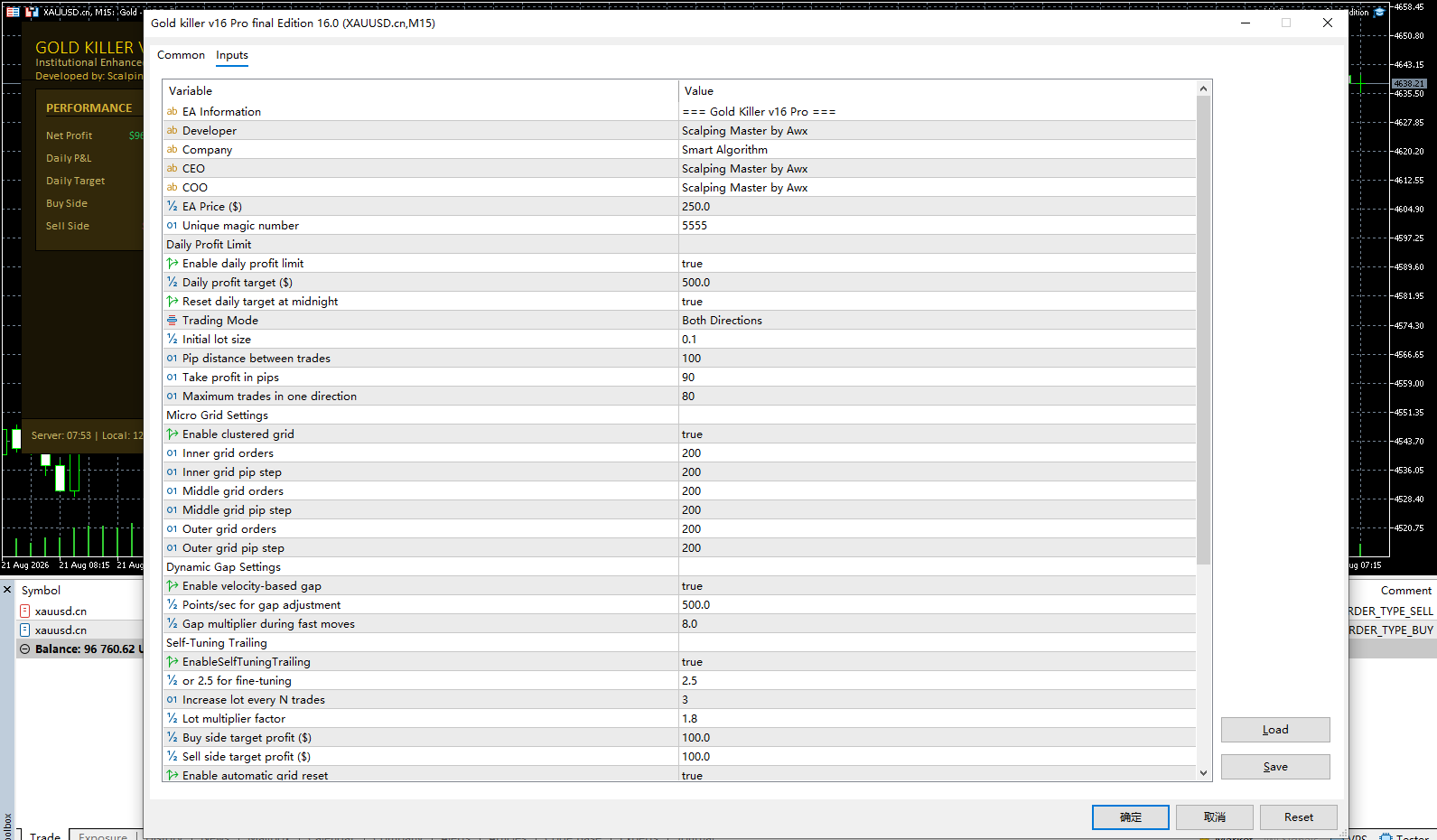
The risk sits in the grid spacing. The EA claims to expand grid distance during fast markets, which reduces the chance of stacking many positions in a single spike. That is a meaningful design choice, not a minor detail. A fixed-spacing grid on XAUUSD can be punished by a $30–$50 move in minutes. A volatility-responsive spacing model gives the recovery layer more room to breathe, but it does not eliminate the basic martingale-like logic: exposure grows when price moves against you.
A daily profit target is also built in. Once the EA reaches its configured goal, it stops opening new cycles for the day. That is a practical guardrail for prop-firm evaluations and for traders who struggle to stop after a good session. It also means the EA cannot chase late-day moves once the target is hit, which some traders will see as a feature and others as a missed opportunity.
Position lifecycle and the reset logic
Each cycle is meant to end in profit before a new cycle begins. The EA resets its grid after a cycle closes, rather than carrying open exposure across sessions. That is a cleaner structure than continuous grid systems that never flatten. It also makes backtesting easier to interpret, because each cycle is a discrete event with a defined start and end.
What installation and configuration look like
The download package contains the .ex5 file and one .set file. Installation is the standard MetaTrader 5 procedure: place the .ex5 in the respective MQL5/Experts folder and the set file in MQL5/Presets, then compile or restart the terminal. Since the EA uses no DLL, there is no need to enable external DLL imports in the terminal settings. That removes one common failure point for users unfamiliar with MT5 security prompts.
The set file is calibrated for a $1,000 account. Traders using a $100 minimum deposit will need to manually adjust lot sizing or run a cent account where one lot represents a fraction of a standard lot. The dashboard panel mentioned in the vendor material allows parameter changes on the fly, but the user is responsible for understanding what each parameter controls. There is no wizard or guided setup.
One practical concern is the licence model. The vendor states NoDLL and Unlimited, which suggests the EA does not phone home and is not tied to a single account number. That is worth confirming before purchase, because licence restrictions can silently break an EA when a trader changes brokers or account numbers.
Realistic expectations for a gold scalper with grid recovery
The vendor supplies third-party performance figures, including a total gain of 113.62 percent and a maximum drawdown of 17.09 percent. Those numbers are not verified by this catalogue and should be treated as marketing rather than a promise. The grid recovery layer means that low-frequency, high-impact losses are possible even when average drawdown looks moderate. A 17 percent maximum drawdown on a backtest can become a 30 percent drawdown in live conditions if gold gaps through stops.
No profit rate or return percentage is presented here as fact. The EA is a tool with a specific behaviour: it scalps gold, stacks positions in losing cycles, and uses a daily target to cap exposure. Whether that behaviour produces steady growth depends on market regime, spread quality, and the user's risk settings. The $2,500 price point places it in the premium tier, and the lack of source code means buyers cannot audit the grid logic themselves.
The most honest way to approach this EA is a forward test on a cent account with the provided set file, watching specifically what happens during a sharp non-news gold spike. That scenario is exactly where the volatility-responsive grid either proves its value or reveals its limits. No single backtest can capture that dynamic.