Trading BTCUSD and XAUUSD with a Controlled Grid
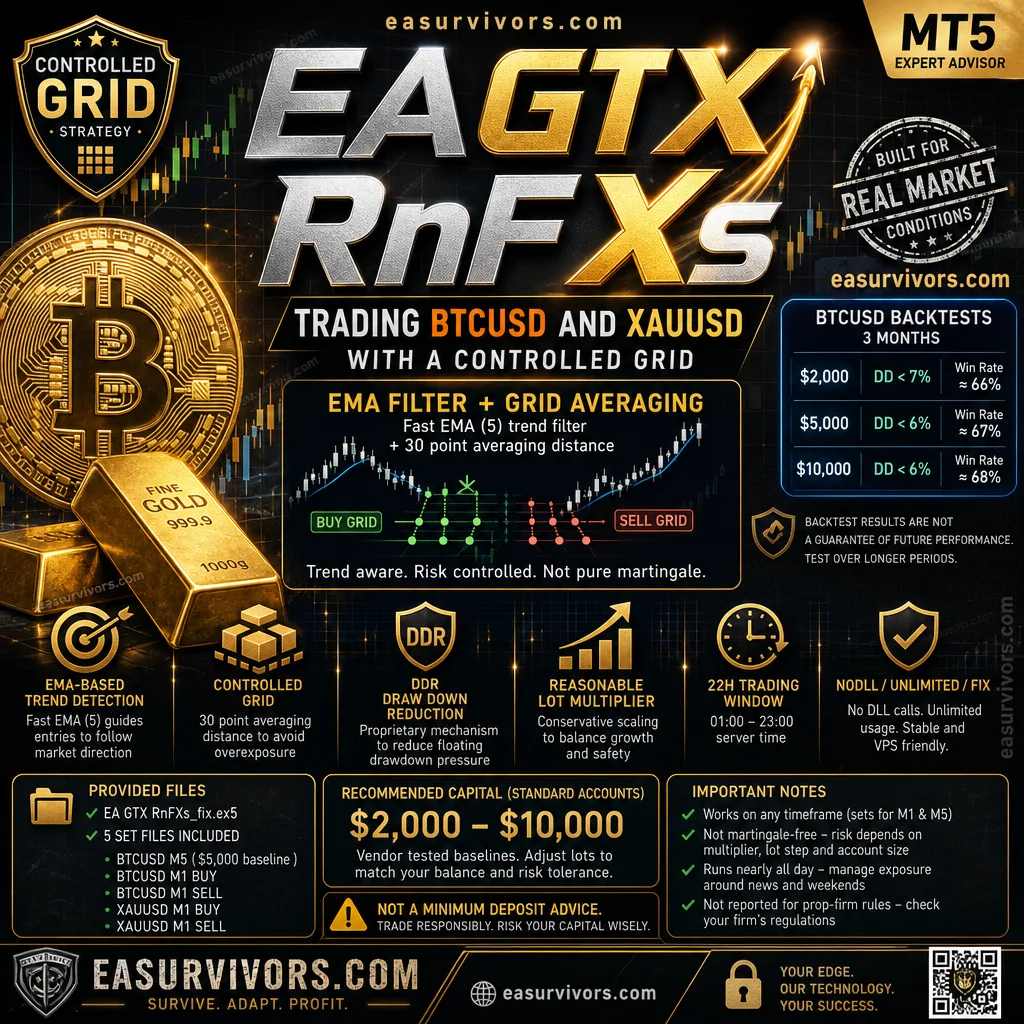
The system pairs two volatile instruments — Bitcoin and spot gold — with a strategy that layers a moving-average trend filter over a conservative grid. Rather than placing orders at fixed intervals regardless of market direction, the EA uses a fast EMA (period 5) to decide when new grid legs should open. This is not a pure trend follower, nor a classic martingale; it sits between the two, scaling into positions while trying to avoid the rapid overexposure that plagues many grid robots.
The vendor describes the approach as 'EMA-based trend detection with dual averaging'. In practice, that means the EA can open positions in both directions under its normal trade setting, but the EMA signal biases where the first entry lands. From there, a 30-point averaging distance spaces out additional layers. That may sound wide in a scalping context, but for BTCUSD and XAUUSD, 30 points is a deliberate attempt to keep the grid from stacking too tightly during fast moves.
The Martingale Question
Any buyer looking at a grid EA will ask how aggressive the lot scaling is. According to the developer, the lot multiplier is intentionally 'reasonable', and a drawdown-reduction mechanism (labelled DDR) can be enabled. The exact multiplier value is not disclosed in the available documentation, so this is a parameter to inspect carefully in the inputs before running live. DDR is presented as an extra layer that tries to cut floating drawdown pressure — but it is a proprietary function, not something you can verify from a description alone. Treat it as a starting point for your own parameter testing, not a guarantee.
Because the EA uses some form of grid averaging, it is not martingale-free. The risk profile depends heavily on account size, lot step, and the multiplier you approve. The supplied set files give vendor-tested baselines for BTCUSD on M5 and for both buy and sell setups on M1. Users must decide whether those presets fit their own risk tolerance.
What the Backtests Tell You — and What They Don’t
The vendor shares three three-month BTCUSD backtests, with starting balances of $2,000, $5,000 and $10,000. The reported drawdowns are low (under 7%), and the stated win rates hover around two-thirds of all trades. Those figures look tidy, but they are vendor-supplied results on a single pair over a single quarter. No statement covers how the EA behaved during a 30% Bitcoin drawdown, a flash crash, or a low-liquidity holiday session. Three months in crypto is a short sample. Test across a longer span, including sideways and falling markets, before judging whether the grid logic can absorb adverse conditions.
The EA is set to trade from 01:00 to 23:00 server time — a 22-hour window. That avoids the thinnest overnight hour, but it still exposes positions to almost the entire daily range. Traders who cannot tolerate overnight gaps on gold or weekend Bitcoin swings need to account for that exposure manually, perhaps by closing positions before major news events.
Setup, Licensing and the Provided Files
The download package contains one expert file (EA GTX RnFXs_fix.ex5) and five set files. The set files cover BTCUSD on M5 with a $5,000 baseline, plus separate buy and sell configurations for BTCUSD and XAUUSD on M1. Having direction-specific set files is unusual and worth noting: the developer likely tuned entries differently for long and short grids, perhaps because the EMA filter behaves asymmetrically on the two instruments.
Licensing is described as 'NoDLL / Unlimited / Fix'. That suggests the compiled expert does not call external DLLs, which is relevant for users who avoid DLL-dependent EAs on rented VPS servers or prop accounts. The 'unlimited' term implies no account-number lock, but confirm with the seller before running it across multiple terminals. Source code is not included; this is a compiled-only product.
The EA works on any timeframe according to its documentation, but the bundled set files are for M1 and M5. If you load it on H1 or D1 without changing the averaging distance and internal timing logic, the behaviour will not match the vendor’s backtests. Stick to the supplied timeframes unless you fully understand the input parameters.
Is the Minimum Deposit Realistic?
The developer states a minimum of 2,000 USC on a cent account. A cent account with 2,000 USC is equivalent to about $20 of notional margin in many broker environments. That is an unusually low capital requirement for a grid EA trading Bitcoin and gold. If you run the supplied $5,000 set file on a 2,000 USC cent account without adjusting lot size, the relative risk will be far higher than the vendor’s backtest implies. Treat the 2,000 USC figure as a technical floor, not a recommendation for live trading at that size.
For a standard (non-cent) account, the vendor’s own backtests use $2,000 to $10,000. A realistic live starting balance on a standard account should probably sit toward the upper end of that range if you intend to use the preset files unchanged. Otherwise, scale lots to match your actual balance and the maximum drawdown you are willing to accept.
Prop-Firm Compatibility
No information is provided about prop-firm drawdown limits or news-trading restrictions. Because the EA runs nearly all day, it will likely hold positions through high-impact news unless you intervene. If you plan to use it in a funded challenge, check the specific rules around holding overnight, weekend exposure on BTCUSD, and maximum open lots. The grid logic could breach daily drawdown limits during a strong trend if you have not tuned the multiplier and averaging distance correctly.