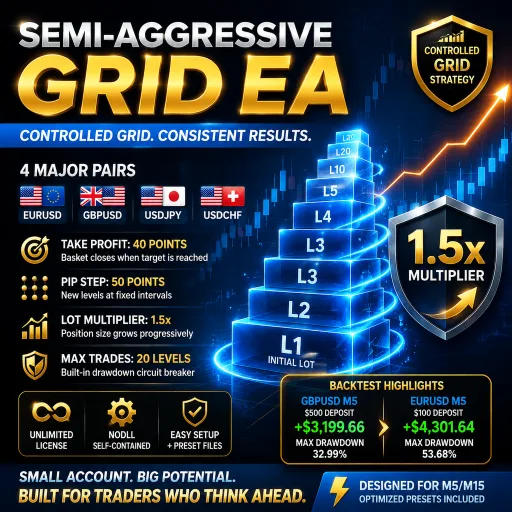
A grid approach built around capital protection
Most grid systems fail because they ignore account-level risk until it is too late. NEO EA takes a different starting point: it treats the equity curve as the primary input for trade management. The developer has placed a hard limit on drawdown that, when reached, forces the EA to stop opening new positions and close the recovery basket. That is a structural decision, not an optional setting, and it changes how the EA behaves in extended adverse moves.
The system is built for EURUSD, GBPUSD, and AUDUSD, but the vendor notes that any pair can be loaded. The M5 timeframe is fixed. With such a short interval, the grid distances matter more than the entry bias. Here, spacing is fixed and the number of levels is capped, which prevents the position count from spiralling during a strong trend. Each layer uses a modest lot increase, never jumping to aggressive multipliers. The result is a predictable basket size, something that is rarely true of comparable grid EAs.
What the micro-lot entry actually does
A $200 minimum deposit is low for a grid system. Micro-lot sizing is what makes it feasible. Because the base position is small, the compounded exposure after several levels remains within reach of a 1:30 leverage account. The trade-off is equally clear: small lots mean small absolute profits per basket. Traders who expect a grid EA to generate fast daily returns will find this product underpowered. Those who measure success in terms of survival time and controlled drawdown will find the design coherent.
How the recovery logic works in practice
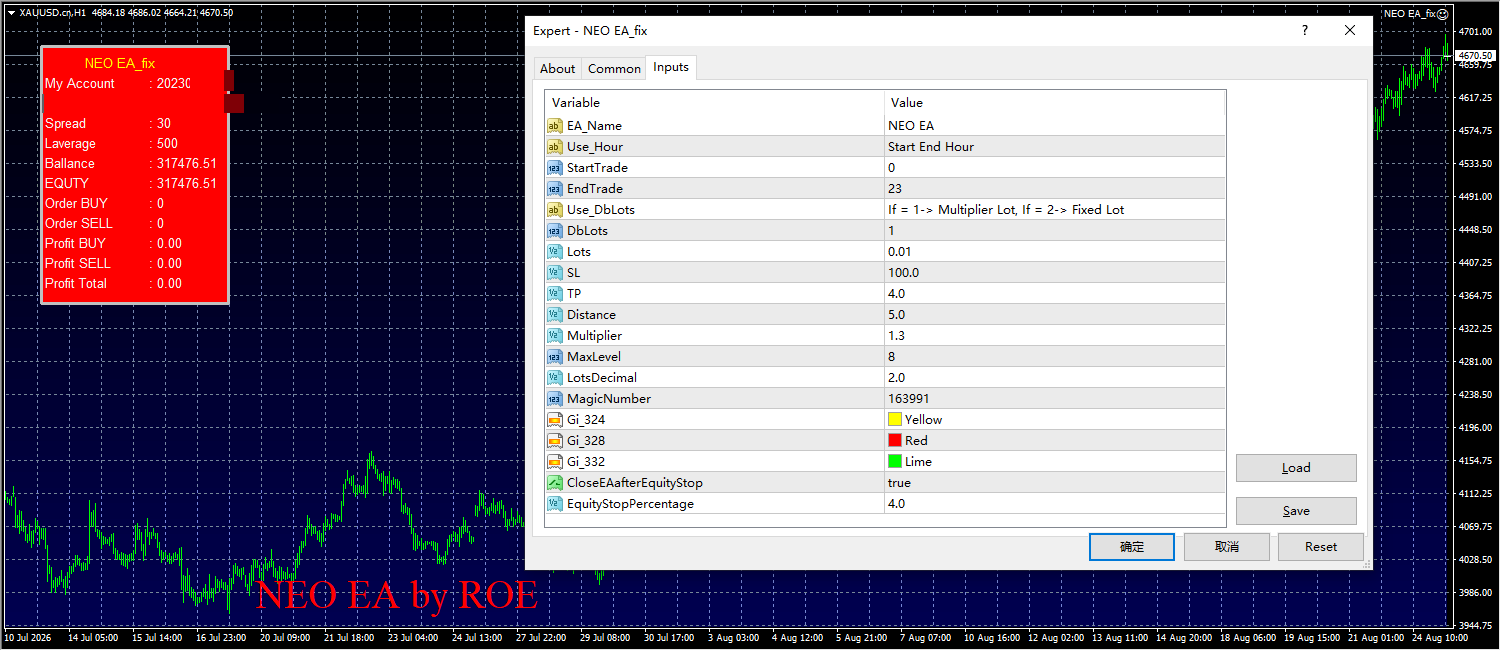
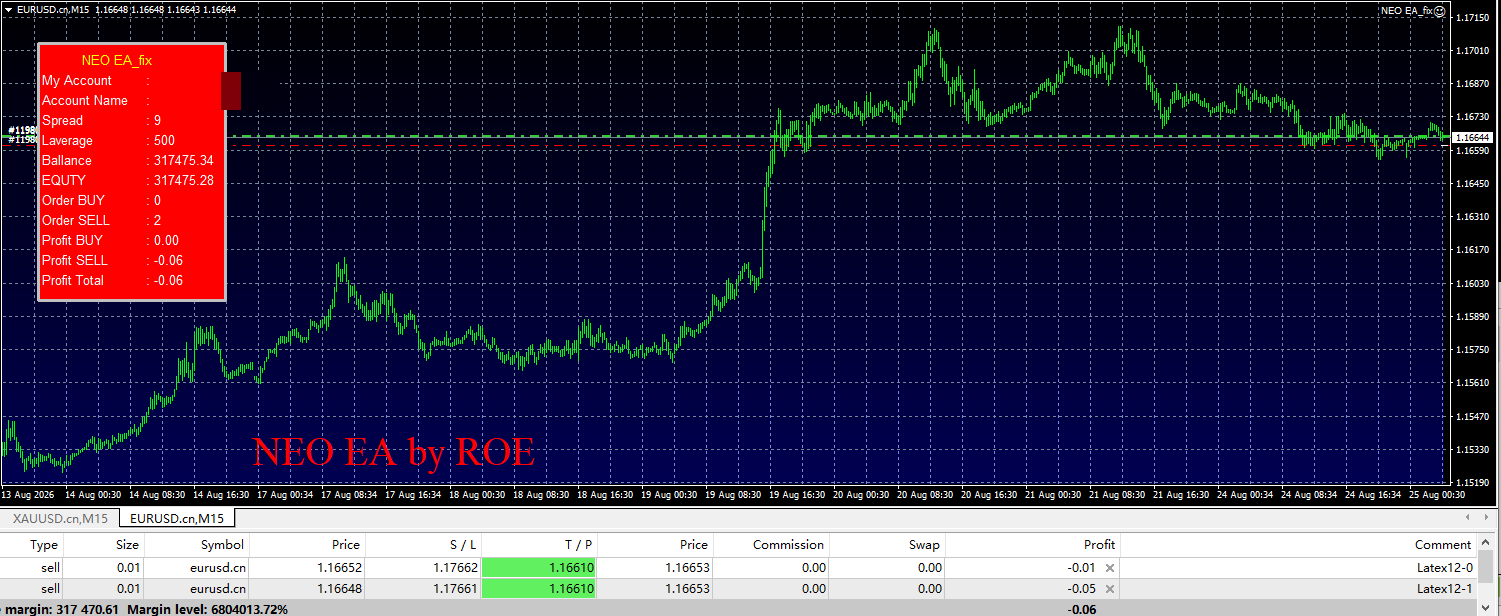
NEO EA opens a new order when price moves a defined distance against the existing basket. The take profit is set as a tight group target, not a per-trade level. Once the combined basket reaches the target profit, everything closes together. That is standard grid behaviour. What is less standard is the equity-based circuit breaker. The vendor has configured a threshold that, once hit, instructs the EA to halt all new activity and exit the market. This is the single most important feature for anyone burned by grids in the past.
Because the grid uses fixed spacing, the EA behaves identically in ranging and trending conditions. The adaptive part is the stop mechanism, not the entry logic. In a prolonged trend without meaningful retracement, the basket will reach its level cap and stop expanding. At that point, the equity protection is the second line of defence. The system does not promise to close every basket in profit. It promises to stop before the account is destroyed. That distinction matters.
Installation and what you actually receive
The download package contains a single executable file, NEO EA_fix.ex4, along with two set files: NEO GBPUSD.set and GBPUSD_$1000.set. The first is the general recommended configuration, while the second is aimed at a $1,000 account balance. Traders running the minimum $200 deposit will need to scale down the lot settings from the $1,000 preset or accept the higher relative risk.
The EA is licence-free in the sense that it does not require a DLL or an online activation. That reduces setup friction and means the file can be copied across multiple MT4 installations without contacting the vendor. It also means the source code is not included. If you want to modify the grid spacing, lot scaling, or equity stop formula, you cannot do so. What you see in the inputs is what you get.
Installation follows the standard MT4 procedure for expert advisors: place the .ex4 file in the MQL4/Experts folder, restart the terminal, and attach it to an M5 chart of the chosen pair. The set files go in the Presets folder and are loaded from the EA's input dialogue. No external libraries or additional runtime environments are needed.
What a sceptical trader should expect
The vendor markets this as suitable for prop-firm challenges. That claim deserves scrutiny. The fixed grid cap and equity stop are consistent with the drawdown limits imposed by many firms, but the M5 timeframe and $200 minimum deposit suggest the design is aimed at small personal accounts first. If you are running a prop challenge with a 5% daily loss limit, you would need to map the EA's equity stop to that exact figure. The default values are not calibrated to any specific firm.
Expect long periods of inactivity followed by bursts of trades when the grid is triggered. The EA operates continuously, but that does not mean it trades continuously. Grid entries depend on price moving far enough to justify a new layer. In tight ranges, nothing happens. In fast moves, several levels can open within minutes. The take profit target is small, so winning baskets close quickly. Losing baskets can remain open for days or weeks until either the target is hit or the equity stop intervenes.
The most realistic use case is a trader who wants to run a low-maintenance grid on a pair they understand, with a hard cap on systemic risk. The absence of source code means you are trusting the developer's risk parameters. The absence of a licence key means there is no vendor lock-in. Both are acceptable trade-offs if you test the EA on a demo account for several months first.