Daily Trade Discipline on US30 and GOLD
Most automated systems fail not because of a flawed entry logic but because they overtrade. This EA addresses that directly by allowing a maximum of one order per day on either US30 or GOLD. The constraint is rigid: once a position opens, no further signals are processed until the next trading day. That alone changes the risk profile. A single losing trade cannot be followed by five more within the same session, which is the usual path to a blown account.
The instrument choice matters. US30 and GOLD are both volatile, news-sensitive markets that reward a conservative approach. The EA operates on timeframes from M5 up to H1, but the one-trade-per-day rule means the timeframe choice is more about entry precision than frequency. Shorter timeframes produce earlier signals; longer ones filter out more noise. Either way, the daily cap stays.
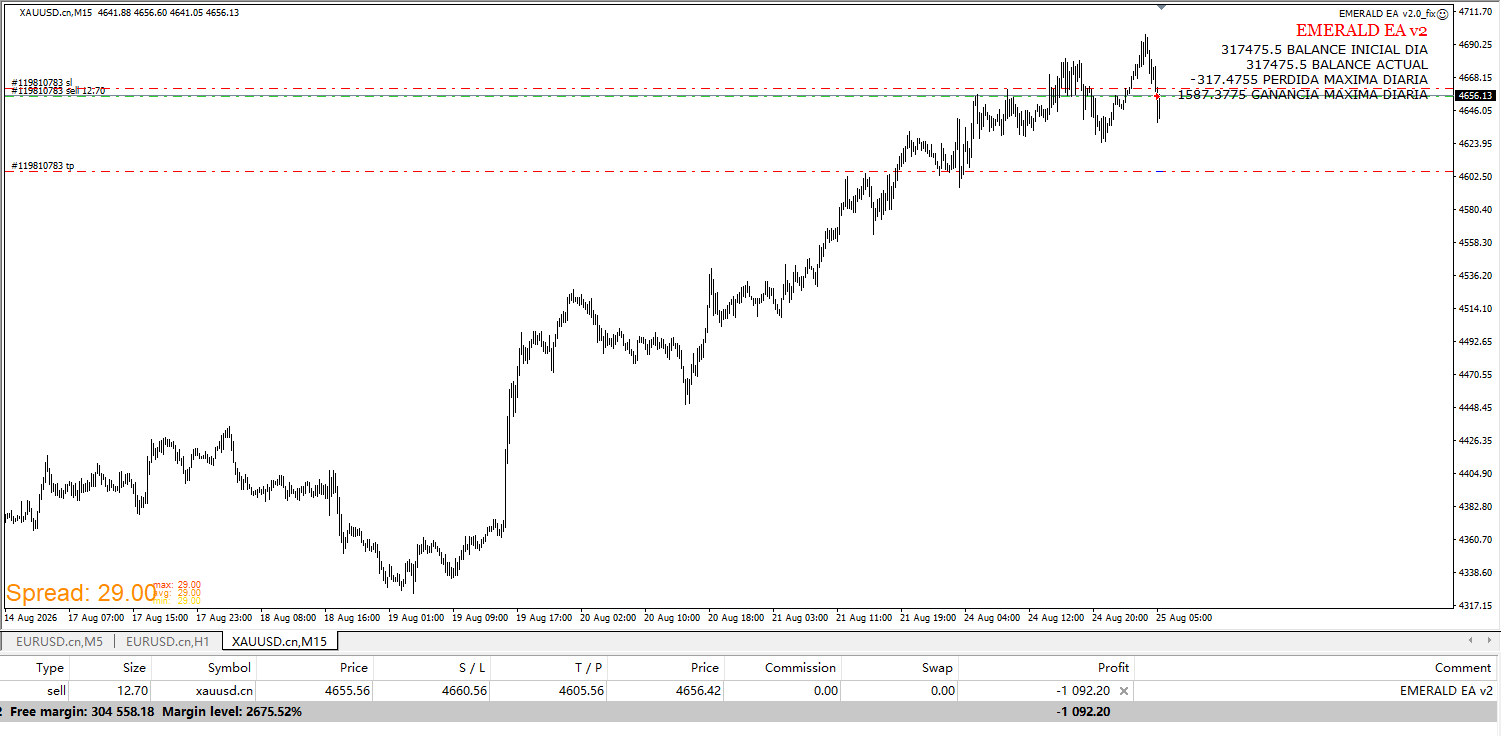
Every order carries an attached stop loss and take profit. There is no option to run without a stop, and the trailing stop function works only within the same daily trade. The developer also includes an autolot feature that scales position size based on account balance, but the set files override this with fixed risk profiles.
What the One-Trade Rule Actually Does
Limiting to one order per day sounds simple. In practice it means the EA must decide whether current conditions justify any trade at all. If the first attempt hits a stop loss, that is the entire loss for the day. There is no averaging down, no grid, and no recovery trade. The vendor marketing does not mention martingale or hedging, and the mechanics of a single daily order exclude both. This is a straightforward, single-position system.
For prop-firm challenges, that behaviour can be an advantage. Many evaluation rules penalise high trade frequency or large intraday drawdown. A system that risks a fixed, pre-defined amount once per day is easier to map against daily loss limits. The developer reports passing FTMO challenges with this EA, but that is a vendor statement and not independently verified.
The obvious objection is that a single trade per day will never produce outsized returns quickly. That is true. The EA is not built for aggressive compounding through trade volume. Its appeal is consistency and a hard cap on daily downside, not a rapid growth curve. Traders expecting multiple signals per hour should look elsewhere; this is closer to a patient, one-decision-per-day system.
Installation, Set Files and Configuration
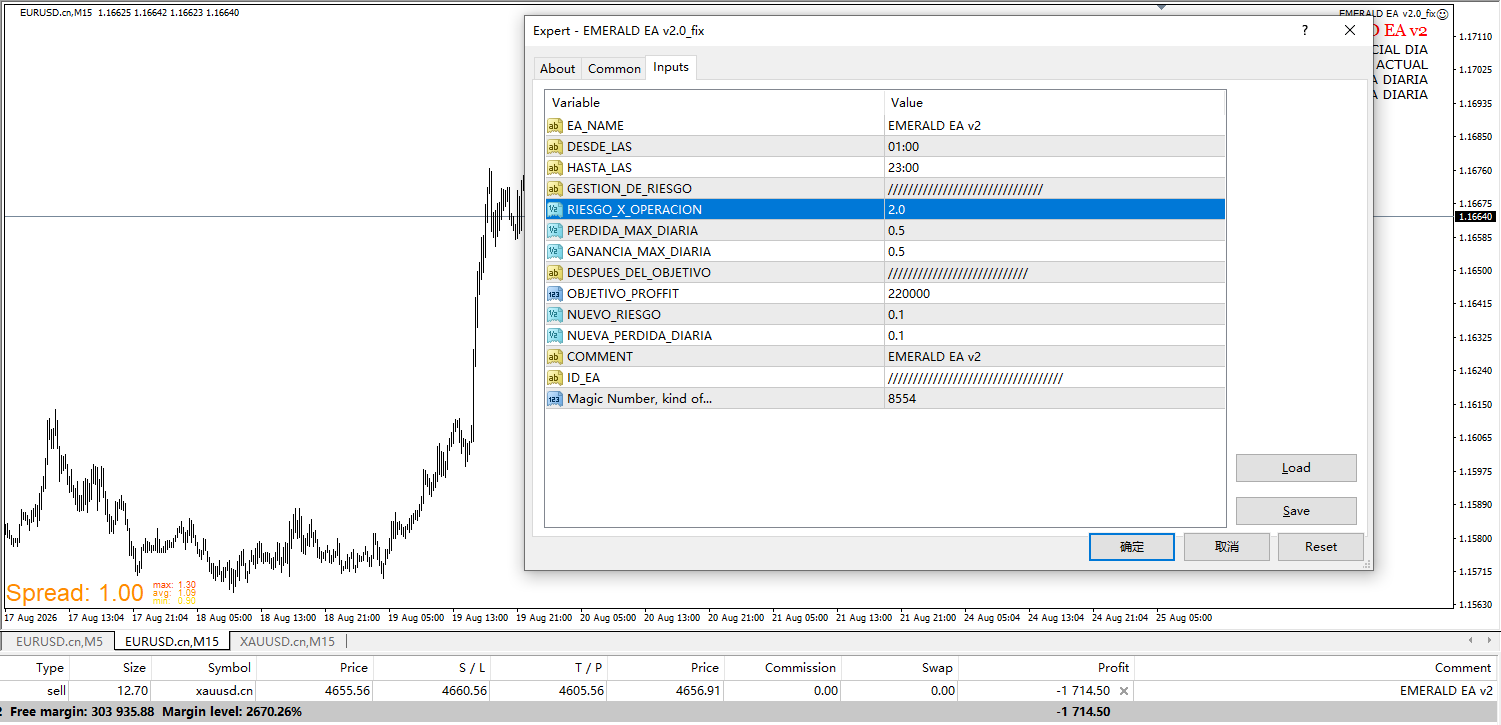
The download contains the compiled EA file (EMERALD EA v2.0_fix.ex4) plus six set files. There is no source code. Installation is standard for MT4: copy the .ex4 into the Experts folder and the .set files into Presets, then restart the terminal or refresh the navigator. The set files are divided by instrument and risk level.
For GOLD, two presets are provided: one for higher risk and one for lower risk, both on the M5 timeframe with a suggested $1,000 starting balance. For US30, four presets exist: high and low risk for $1,000 accounts and high and low risk for $10,000 accounts, also on M5. The timeframe can be changed manually, but the provided presets are tuned for M5 operation. Traders who prefer H1 entries must adjust parameters themselves.
The licence is described as "NoDLL / Fix". This indicates the EA does not require external DLL calls, which reduces installation conflicts and makes the file more portable across Windows versions. It also means the EA cannot access external data feeds or hidden server-side logic. All decisions come from the local MT4 environment.
Matching Risk to Account Size
Using the wrong set file is the most common way to damage an account. A $10,000 high-risk preset loaded onto a $1,000 account will produce position sizes that are ten times larger than intended. The set file names make the intended balance explicit, but that only works if the trader reads them. Before activating the EA, compare the preset name against the actual account balance and, if necessary, start with the lower-risk version until the daily loss in currency terms is acceptable.
Autolot is included, but the set files fix the risk per trade. If a trader enables autolot and then changes the account balance, position sizes will adjust automatically. That can be useful for prop-firm scaling but also removes the manual check that a fixed preset provides. Decide before going live whether the EA should use fixed lot sizing from the set file or the dynamic autolot logic.
Realistic Performance Expectations
Backtest figures from the vendor show a seven-month test on XAUUSD with a $1,000 start, a net profit of $1,348.43 and a maximum drawdown of 29.92%. On US30 with a $10,000 start, the reported net profit is $54,578.98 with a maximum drawdown of 33.85%. These are vendor-reported results, not live account statements, and they reflect a specific historical period and parameter set. A 30% drawdown means a $10,000 account would at some point be down roughly $3,000 before recovering. That is within the stated risk but high enough to trigger emotional exits for some traders.
The discrepancy between the two pairs is instructive. US30 produced roughly 5.5 times the starting balance in seven months, while GOLD produced 135% in the same period. That does not mean US30 is always better. It means the asymmetry between the two markets is large, and a trader who splits capital between both pairs should expect very different equity curves. The one-trade-per-day rule further amplifies this: a single missed day on US30 can mean a large foregone profit, while a single stopped trade on GOLD wipes the entire daily allowance.
Minimum deposit is set at $500, which is viable only with the low-risk preset on a small-lot broker account. At that level the profit per trade will be modest, and a single losing streak of five or six days could draw the account down by more than 10%. Traders who cannot tolerate that should use the $1,000 or $10,000 presets as the vendor intends.
The EA does not trade cryptocurrencies, currency pairs other than those listed, or indices beyond US30. It is not a multi-market solution. The value proposition is narrow: fixed daily risk on two volatile instruments, with no DLL dependencies and a transparent set file structure. That narrowness is a feature for some and a limitation for others.