Why passing evaluation accounts fails with discretionary methods
Evaluation accounts punish one thing above all: inconsistent risk. A trader who manually overrides stops, widens targets on impulse, or exits too early can rack up acceptable returns and still breach a daily drawdown limit. The problem is not always the strategy; it is the execution drift that creeps in over days and weeks. Automating the process removes that drift, but only if the software enforces the same risk envelope on every trade, including trades taken during thin liquidity or after a losing streak.
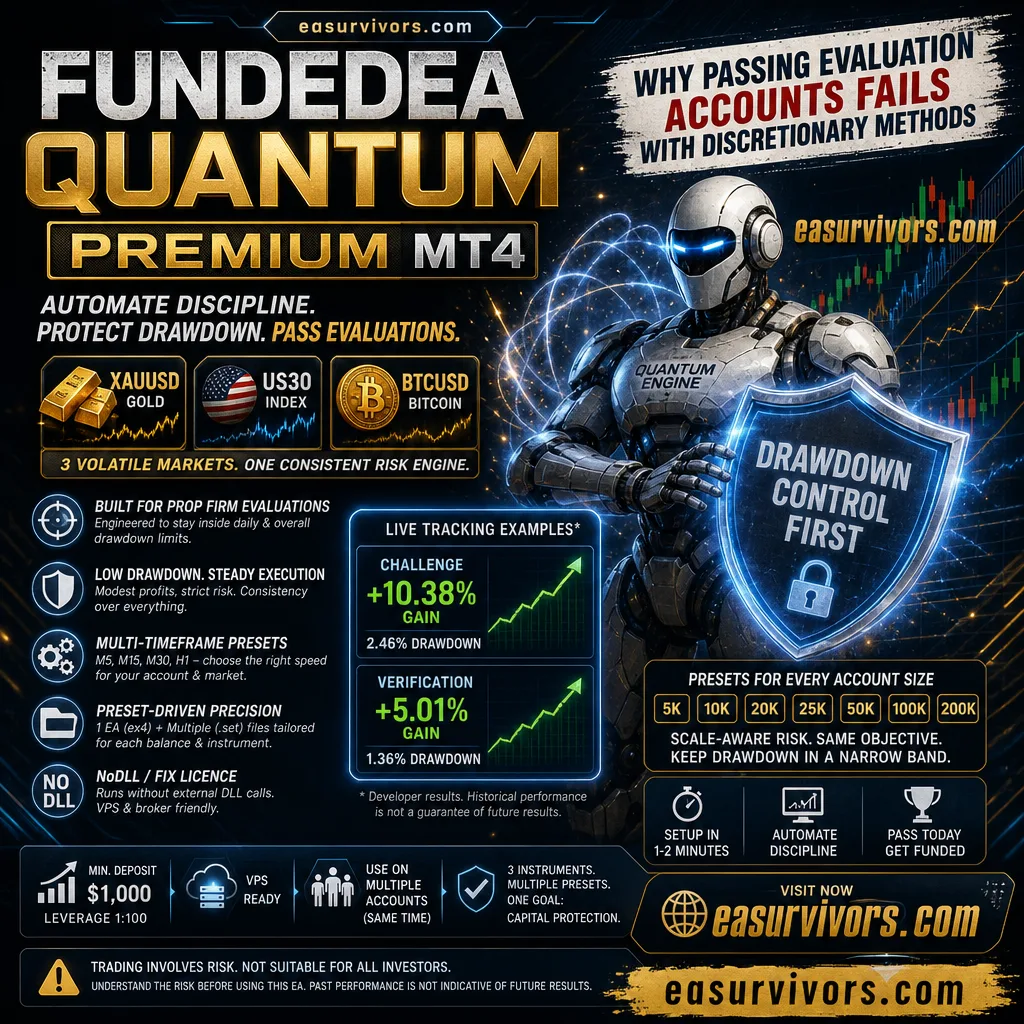
FundedEA Quantum Premium MT4 addresses this by treating drawdown control as the primary constraint. The system does not chase the highest possible return; it aims to keep losses inside a narrow band while taking modest profit opportunities across three volatile markets. The vendor positions it for FTMO-style evaluations, but the same logic applies to any account where a fixed loss limit matters more than maximum gain.
How the trading logic stays inside the risk envelope
The expert advisor uses a configurable set of parameters across gold (XAUUSD), the US30 index, and Bitcoin (BTCUSD). No single timeframe defines the system: the presets cover M5, M15, M30 and H1 charts, each paired with a specific market and account balance. A 5-minute gold preset exists for smaller accounts from $5k, while a separate H1 gold preset targets a $100k balance. This is not a one-size-fits-all exposure model; the position sizing and stop distances change with the instrument and the account size.
Each preset reflects a different balance of frequency and heat. The US30 group includes a 'SAFER' configuration that trades less often and takes smaller exposure per trade. Bitcoin presets include a 1-minute setting, a 5-minute setting with a 25-pip stop, and several longer-interval variants. Traders who want fewer signals can select a slower timeframe and a safer profile; those willing to accept more frequent trades can move down to M5 with a correspondingly higher allocation. The vendor applied a NoDLL/Fix licence, meaning the EA runs without external DLL calls — a practical advantage for VPS deployment and for brokers that restrict custom library functions.
Preset files shape the behaviour more than the EA itself
The download package includes one core .ex4 file plus a set of .set presets. The presets, not the EA alone, determine how the system trades on a given account. For example, the package ships separate 5-minute gold presets for $5k, $10k, $20k, $25k, $50k, $100k and $200k balances. Each preset adjusts lot sizing and stop placement to keep the percentage risk roughly constant as equity grows. This is a deliberate design: a fixed-lot EA would become progressively riskier as the account compounds, but a scale-aware preset keeps the drawdown profile similar from one stage to the next.
The vendor reports backtesting and live tracking figures that include a 10.38% gain with a 2.46% drawdown on one challenge and a 5.01% gain with a 1.36% drawdown on a verification phase. Those numbers are attributed to the developer and should be treated as historical examples, not guarantees. The claims are plausible for a system designed around low drawdown, but every set of preset files will behave differently depending on the broker feed, spread widening, and slippage during volatile US30 or Bitcoin sessions.
How to configure the system for different account types
The minimum recommended deposit is $1,000 with 1:100 leverage. On an MT4 account, the user installs the EA on the relevant chart, loads the correct preset for the account balance, and leaves the system running. The vendor suggests the setup takes one to two minutes, and the package arrangement supports that: pick the balance bracket, pick the instrument and timeframe, and attach the corresponding .set file. No source code is included, so all adjustments happen through the input fields and preset files.
For prop firm accounts, the relevant constraint is not just the starting balance but the trailing drawdown rules. A $100k evaluation account with a 10% max drawdown has a different risk budget than a $25k live account with a 5% daily stop. The preset naming reflects that: files labelled with specific balances (5k, 10k, 25k, 50k, 100k, 200k) map to typical challenge sizes. A trader who passes a $25k evaluation and then receives a $100k funded account should switch to the 100k preset rather than continuing with the old file.
Limitations that must be accepted before running the EA
The system only trades three instruments: gold, US30 and Bitcoin. That is a deliberate concentration rather than a bug — all three are high-volatility, high-spread products that require careful stop placement and realistic expectations about slippage. On an ECN account, gold spreads widen during rollover; on a fixed-spread account, Bitcoin quotes can pause entirely. A preset that works on a backtest may produce different fills on a live feed, especially on the 1-minute Bitcoin preset where every pip of spread eats into the stop distance.
No DLL calls means the EA will not fetch external news feeds or sentiment data. It is a self-contained rule engine, not an adaptive machine-learning model despite the vendor's 'Quantum' branding. The automation removes emotional execution, but it does not remove market risk. The vendor's historical figures show low drawdowns, yet low drawdown in the past is not the same as an upper bound on future losses. Traders must monitor broker conditions, swap charges on Bitcoin positions held overnight, and the spread behaviour during US30 reopen periods.
The licence allows use on multiple accounts simultaneously, which is convenient for traders running a personal account alongside a challenge account. But that convenience should not translate into higher aggregate risk. Running three instances on three accounts with three different presets can still concentrate exposure in the same instrument across all three, creating a correlation that is easy to miss when each account is viewed separately.