Traders who will find this EA useful
This expert advisor is aimed at traders who want a systematic, automated approach to gold scalping and are willing to accept the characteristics of a grid-like entry method. It is not a hands-off solution for someone who wants to ignore the account for weeks. Because it opens multiple positions in sequence, the user should understand how adding to a position affects margin and floating drawdown. Traders who prefer a single entry with a wide stop loss will likely find the behaviour unfamiliar.
Those who value transparency in code will appreciate that the package contains the MQ4 source file, not just the compiled executable. That makes it possible to inspect the logic, adjust parameters, or verify that risk controls work as described. The unlimited licence means the EA can be used on any number of accounts without recurring fees.
How positions are opened and managed
The EA focuses exclusively on XAUUSD, taking trades on the M1 and M5 timeframes. The core idea is to capture small price movements repeatedly rather than hold for large trends. A fixed take profit, defined as a percentage of price or account equity, closes each trade quickly. A trailing stop then locks in gains when the market moves favourably, allowing a position to run beyond the initial target under the right conditions.
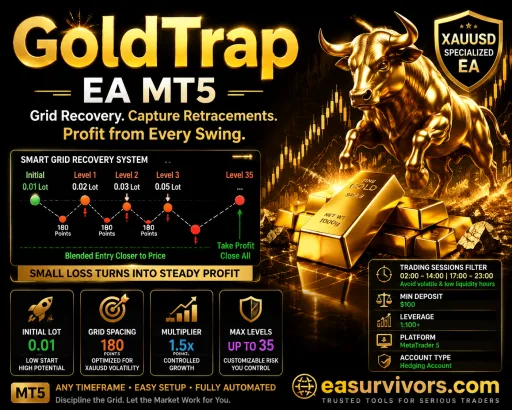
When a trade moves against the open position, the EA places additional orders at a fixed price interval. This grid-like spacing lowers the average entry price of the basket, aiming to close the whole group at a small net profit. The method is common in mean-reversion scalping but carries a specific risk: a sustained move in one direction creates a growing stack of open positions. The EA includes a time filter to restrict trading to periods of higher liquidity, which reduces the chance of entering during thin, erratic gold trading hours.
What the presets change
The downloadable package includes three set files for the M1 timeframe: Red_High_risk_M1.set, Red_Medium_risk_M1.set, and Red_Low_risk_M1.set. Each preset adjusts the distance between grid orders, the size of the take profit, and the trailing stop parameters. The low-risk preset uses wider spacing between orders and a smaller initial lot size relative to the account balance. The high-risk preset trades more aggressively in both frequency and position sizing. The source code allows traders to create their own presets for the M5 timeframe as well.
Account minimums and recommended environment
The vendor lists a minimum deposit of $100 for this EA. That figure is realistic only when paired with the low-risk preset and a cent or micro account, where position sizes can be kept very small. On a standard account, a $100 balance leaves little room for a grid of gold positions, even with leverage of 1:100 or higher. Traders using the medium or high-risk presets should consider a larger buffer, because the EA may hold several open positions at once during a drawdown phase.
Leverage of at least 1:100 is required. Lower leverage would sharply reduce the number of grid levels the account can support before hitting margin limits. The EA was tested on an ECN-style account with tight gold spreads, which is relevant because scalping small price moves depends on low transaction costs. A broker with wide fixed spreads on XAUUSD will erode the profit margin on every trade. Slippage control is another practical consideration, especially around high-impact news events when the liquidity filter may not fully protect order execution.
Because the EA trades on M1 and M5 charts, a stable connection to the MetaTrader 4 server matters. Price data on these timeframes updates every minute, and a gap in connectivity can cause the EA to miss an entry or exit signal. The vendor has verified performance on third-party trackers for periods in 2020–2022, but those results are not guarantees of future behaviour. Past gold volatility differs from today’s market conditions.
Points that need attention before live trading
The grid-like entry method is the main risk. When gold trends strongly in one direction, the EA keeps adding positions at fixed intervals. The floating loss grows with each new order, and the margin required increases accordingly. The built-in percentage-based stop loss is meant to close the entire basket when the drawdown reaches a preset threshold, but the actual loss depends on the executed prices, not theoretical levels. A fast market can produce slippage on both entries and the final stop-out order.
The time filter helps avoid low-liquidity sessions, but no filter can eliminate all news-related spikes. Gold reacts sharply to central bank statements, inflation data, and geopolitical events. A trader running the high-risk preset during such periods should expect larger drawdowns than the backtest figures suggest. Regular monitoring is recommended, at least daily, to check the number of open grid levels and the margin use.
The source code is a genuine advantage. A trader can verify that the trailing stop and time filter work as described, audit the grid spacing logic, and change the magic number to avoid conflicts with other expert advisors on the same terminal. However, modifying the code also means the trader takes responsibility for any new behaviour. The vendor’s own testing covers the default presets, not custom variations.
License terms are unlimited, so there is no restriction on the number of accounts or rental expiry. The $1,900 price reflects the inclusion of source code and the vendor’s brand positioning. Traders who only need the compiled EA may find the package more than they require, but those who want to learn from or adapt the logic will see the source access as the primary value.