Installing and configuring Gold Breaker on MT5
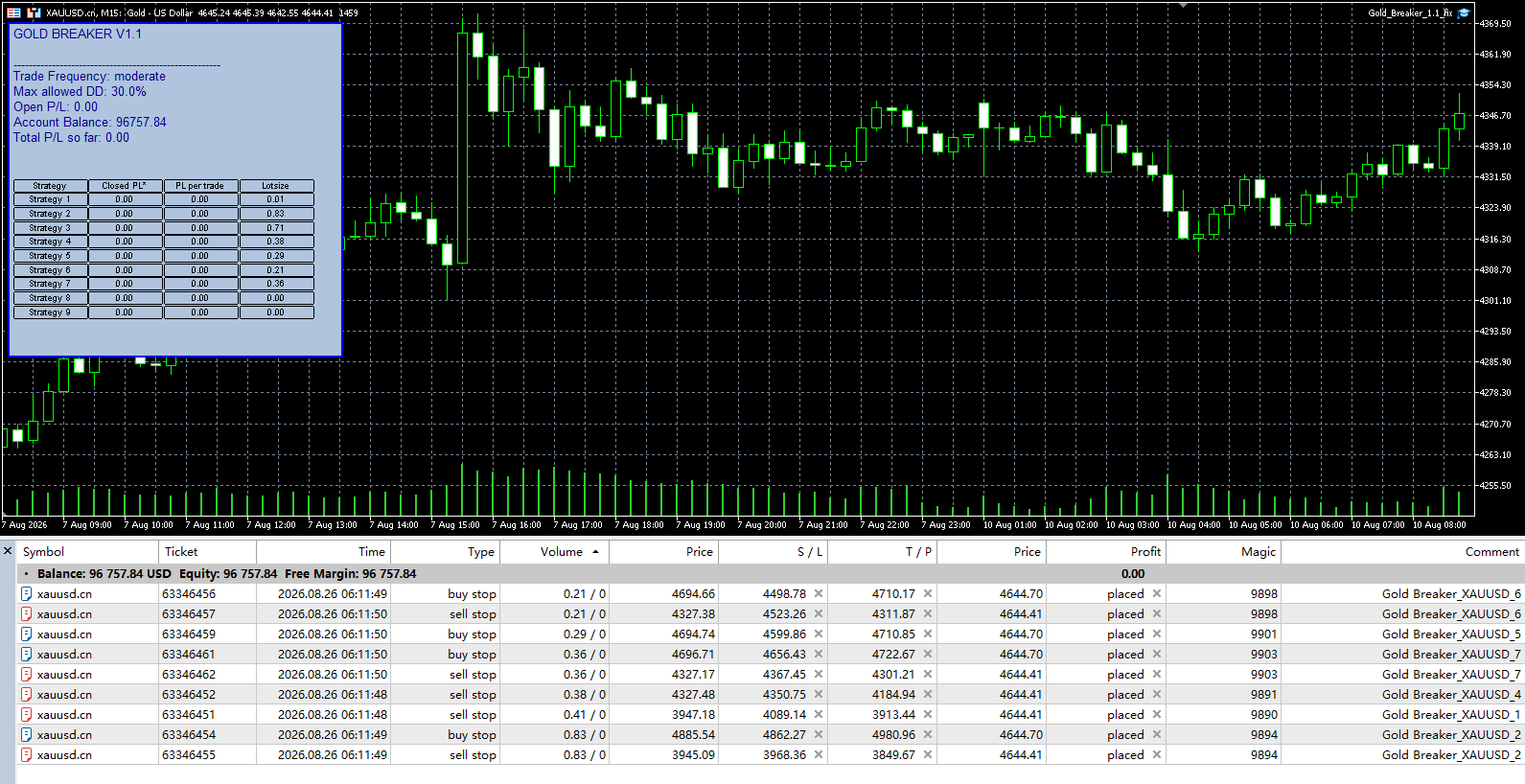
Gold Breaker EA MT5 runs on the H1 timeframe of XAUUSD and requires MetaTrader 5. The minimum suggested starting balance is $500 on an ECN or raw spread account with leverage of at least 1:50. After attaching the EA to a chart, the first decision is how risk should be calculated: the EA can use either the current account balance or the account equity as the base for lot sizing. A custom magic number (9889) ensures the EA only manages its own trades, so it can run alongside other systems on the same terminal.
The original version is delivered without source code, and the licence is tied to a single installation. A virtual pending order system replaces broker-side expiration, so behaviour stays consistent when the broker does not support certain order types or expiry rules.
Reading and responding to gold breakouts
The EA scans XAUUSD price action for momentum-driven breakout setups. When a breakout is confirmed, it places a market or pending order according to its internal logic. Each position is assigned a stop loss and take profit automatically; there is no manual entry step. The virtual expiration mechanism then monitors any unfilled pending orders and removes them when their internal timer ends, independent of the broker.
NFP protection layer
One of the more distinctive features is the Non-Farm Payroll filter. Before a scheduled NFP release, the EA can be configured to close open positions, remove pending orders, or pause trading entirely for a set window. The goal is to avoid being caught by the sharp spike and immediate reversal that often follows the data release. The vendor presents this as a core design choice rather than an optional add-on.
Choosing a risk profile that fits the account
Two settings define most of the day-to-day behaviour: a maximum drawdown threshold and the risk base. The drawdown limit is exposed as a parameter, with the vendor citing 30% as a default. When account drawdown reaches that level, the EA stops opening new trades. The risk base determines whether the EA calculates position size from the balance or the equity; equity-based sizing tends to reduce lot sizes after floating losses, while balance-based sizing keeps lot sizes stable until the drawdown limit is hit.
The vendor also publishes third-party tracking data for this product. The monitored account began with $1,615 and grew to a balance of roughly $5,356 over the tracked period, with a maximum drawdown close to 17%. Monthly results varied from about 1% to over 18%. These figures are reported by the vendor and reflect one account; they are not a forecast.
Where the system is likely to struggle
The strategy is designed for breakout conditions in gold. During prolonged consolidation or low-volatility sessions, breakout signals tend to fail more often, and the EA has no stated range-trading or mean-reversion mode to fall back on. The NFP filter reduces exposure around one specific event, but other high-impact releases or unexpected geopolitical shocks are not filtered by default. Users who prefer to see and approve each signal before it reaches the market will also find the fully automated order placement difficult to supervise on a trade-by-trade basis.
Finally, the $1,200 licence cost and the lack of source code mean the system is not suitable for traders who want to modify the logic or test it on a demo account before committing to a live setup.