Who this system is meant for
News Catcher Pro EA MT4 is built around scheduled economic releases. The trader who gets the most out of it already follows the news calendar, understands which figures tend to move GBPUSD, EURUSD and EURGBP, and is prepared to sit out most sessions. It is not a set-and-forget trend follower, and it is not a high-frequency scalper. The entry logic is selective: the EA waits for specific volatility conditions before a news event and then manages the position according to mean reversion principles.
A trader who ignores the calendar or runs the EA on an account that prohibits news trading will find the tool uncomfortable. The same applies to anyone expecting constant daily activity. This is an instrument for a particular style of trading, not a general-purpose income generator.
Entry logic around scheduled releases
The core assumption is that major news events push currency pairs away from their short-term average, and that price often snaps back within minutes or hours. The EA scans for the approach of high-impact events, then checks volatility inputs before committing a position. Price channels and daily ATR feed into the entry filter, while the M5 timeframe keeps the reaction window tight.
Mean reversion after a news spike is not the same as trading the spike itself. The EA is designed to wait for the initial dislocation, not to chase the first tick. This makes the entries more conservative than a classic news spike straddle, but it also means the system depends on adequate liquidity right after the release. On the three assigned pairs, that liquidity is normally present during London and New York hours.
One chart, three pairs
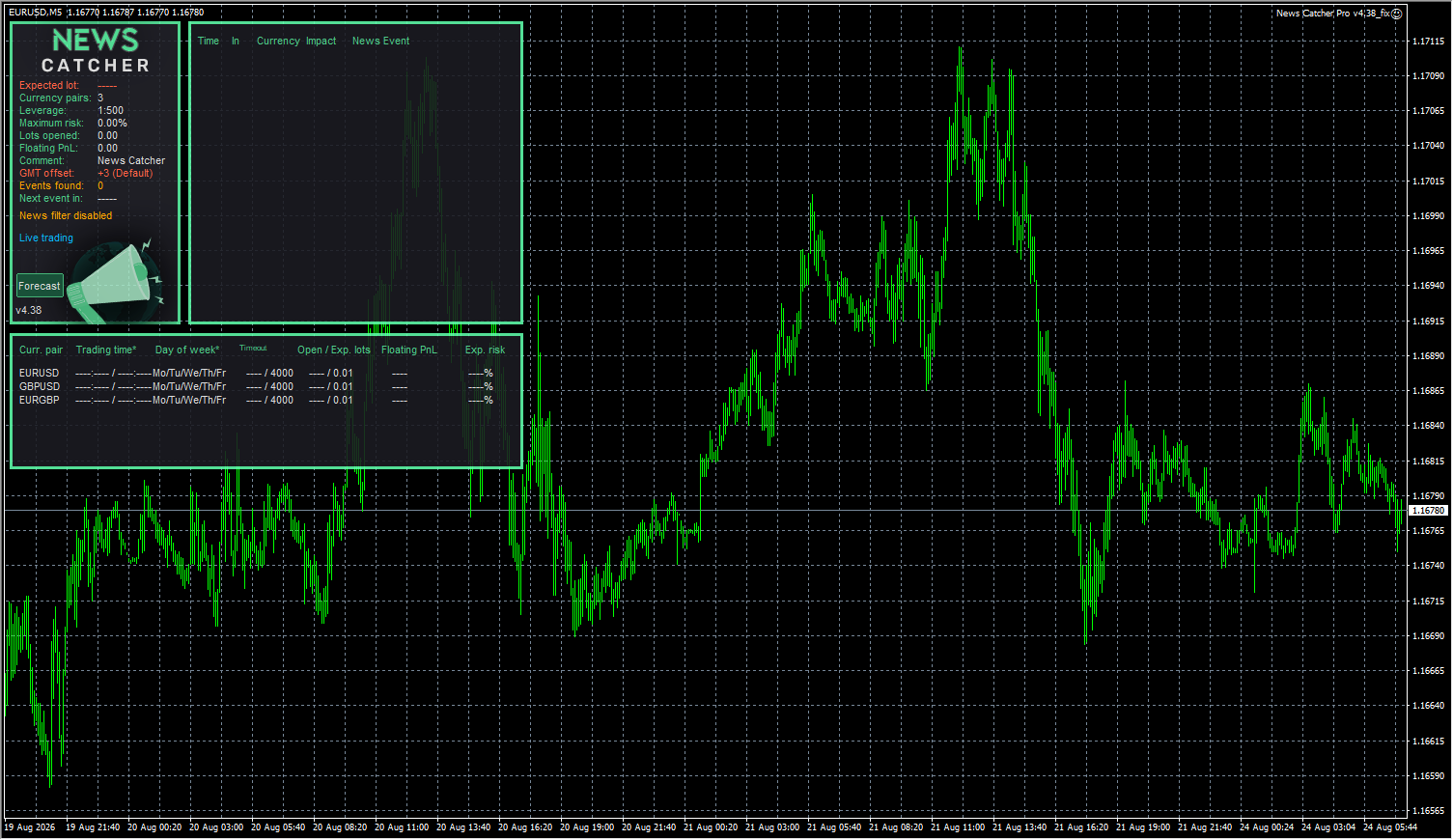
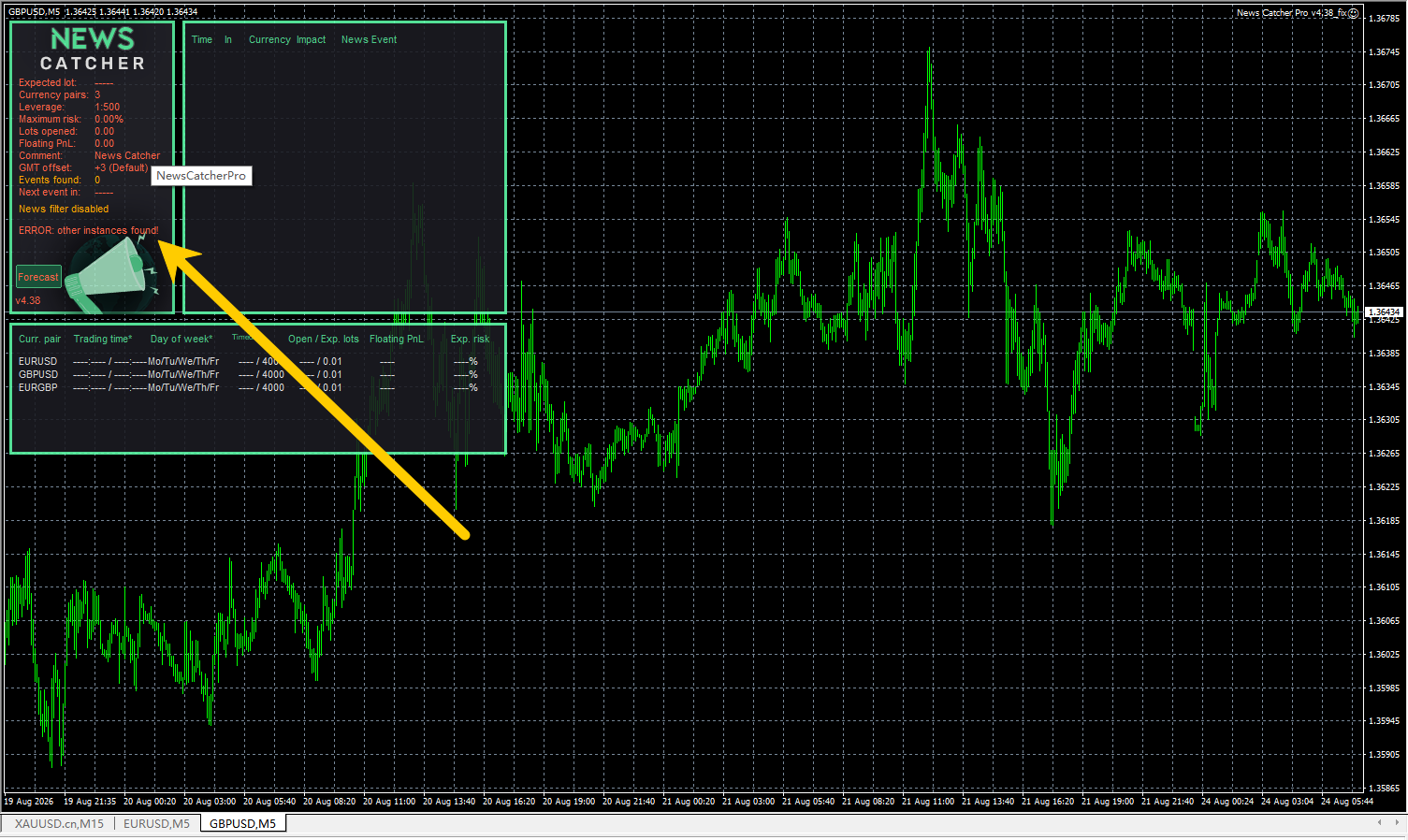
A practical point: the EA can be attached to a single M5 chart and still monitor GBPUSD, EURUSD and EURGBP. That simplifies setup considerably. The user does not need to open three charts or run separate instances. Position management, including hedging options and maximum open positions, is controlled from the same panel.
Account requirements and setup
The vendor lists a minimum deposit of $100. That is the floor, not a recommendation. With three pairs and news-driven volatility, the sensible account size depends on risk per trade and the broker's stop level policy. Leverage is not a constraint: the EA reports no fixed leverage requirement, so it can run on high or low leverage accounts.
Broker conditions matter more than usual here. News trading requires a broker that does not widen spreads excessively during releases and does not reject or delay orders in the seconds around the event. An ECN-style account with variable spreads is the typical pairing, but the product documentation does not endorse any specific broker. The user must verify that their broker permits news-based strategies and has acceptable execution during releases.
Set files are included: one default, one with trailing and profit limits, and one adding a hedging variant with additional trades. The licence is NoDLL, meaning no external DLL calls are required, and the package ships as a fixed .ex4 file. No source code is provided.
What deserves attention before buying
The most obvious risk is execution. A mean reversion system that opens just before a major release can be seriously affected by slippage, spread widening, or order rejection. Backtest results, which the vendor says range from 2008 to 2024, often assume perfect execution and cannot replicate the stress of a live news spike. The developer reports a maximum drawdown of 18.3% in a real-account signal, but that figure comes from their own published account, not from independent verification.
Another point is the selective nature of the EA. There will be days, sometimes weeks, without a trade. A trader expecting regular activity may disable the filter out of impatience, which changes the system's behaviour entirely. The same applies to the time-management settings: position holding time and Friday closing time are user-adjustable, so the operator can inadvertently override the safety defaults.
Finally, because the robot trades before scheduled events, it cannot be tested on a random stretch of historical data and expected to show the same characteristics. The vendor supplies set files and a news filter that can be used in backtesting, but the accuracy of that filter depends on the historical news database available to the tester. Any backtest should be read with that limitation in mind.