Which traders fit this system
Volume Scalper EA is built for traders who already understand the mechanics of intraday scalping and accept that short-term positions carry both opportunity and frequent market noise. It suits users who monitor lower timeframes, are comfortable with automated stop placement, and can tolerate periods of drawdown while the EA filters for its specific entry signature. It is not intended for long-term position traders, those who prefer discretionary entry, or anyone expecting an EA to trade without occasional losing sequences.
How the EA identifies and executes trades
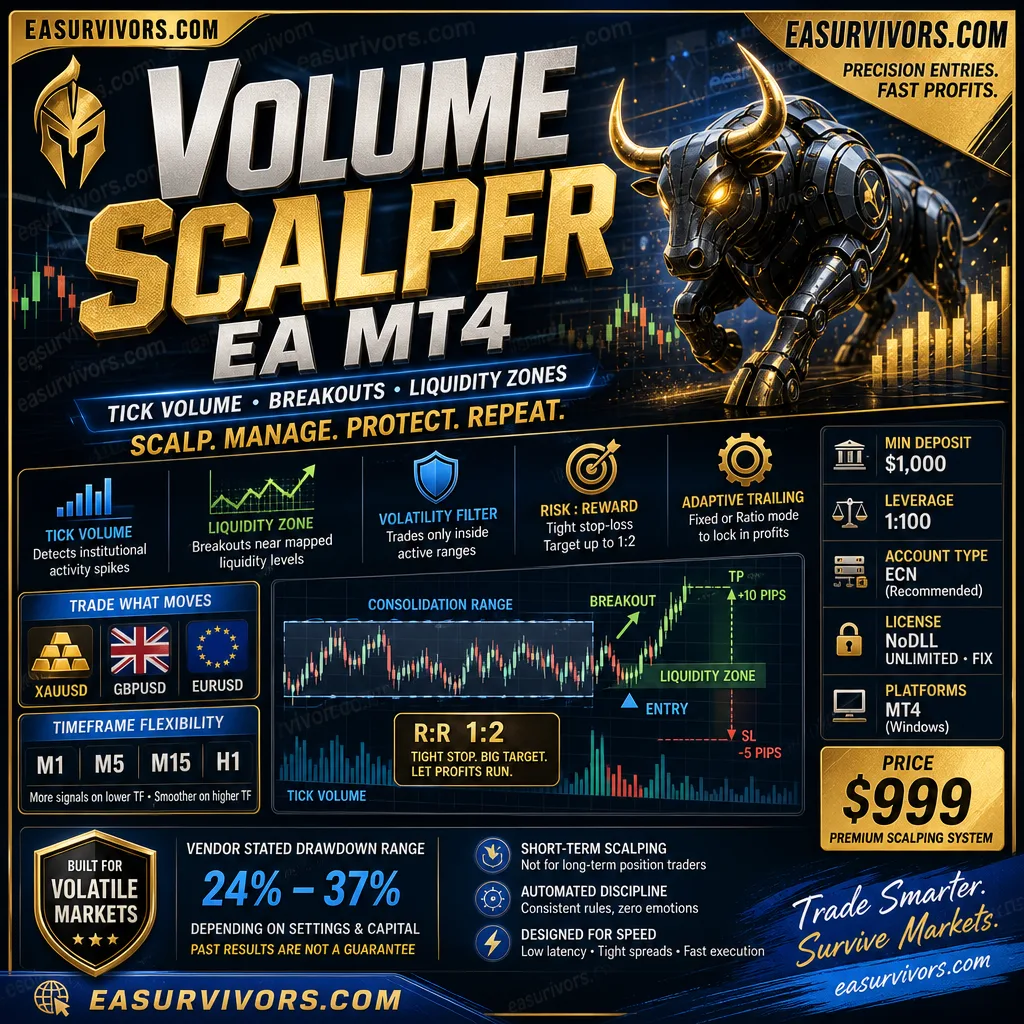
The core logic revolves around tick volume, which is used as a proxy for institutional activity. The EA scans for consolidation ranges, then waits for a breakout to occur near a previously mapped liquidity zone. A volatility channel acts as a gate: if price is outside the defined range, the EA stands aside. When both conditions align, it opens a position with a tight stop-loss and aims for a reward ratio near 1:2. The trailing mechanism can be configured in fixed or ratio mode, letting trades run while protecting accrued profit during fast moves.
The system is described by the vendor as a hybrid of three components: volume-based breakout detection, volatility mapping for range filtering, and adaptive trade management. In practice, that means it does not enter on every small spike. Instead, it waits for a combination that suggests a genuine momentum shift inside an active liquidity pocket. This is a scalping approach, not a trend-following method, so holding periods are generally short and frequency depends on market conditions.
Instrument and timeframe coverage
The EA is provided for XAUUSD, GBPUSD, and EURUSD, but the underlying logic can apply to any currency pair. It runs on M1, M5, M15, and H1 charts. Lower timeframes will produce more signals but also more exposure to spread and slippage; higher timeframes reduce frequency but smooth out some noise. The choice of chart does not change the core logic, but it does change how frequently the EA evaluates market conditions.
Account and broker requirements
The minimum deposit specified is $1,000, with recommended leverage of 1:100. The vendor suggests any ECN account type, where tighter spreads and faster execution tend to benefit a scalper that works with tight stops. No specific broker is endorsed, but low-latency connectivity matters when the EA is trading gold or major forex pairs in volatile sessions.
License terms are described as NoDLL, unlimited, and fix, meaning the compiled file does not require external DLL calls and can be used on multiple terminals without additional unlock requests. Source code is not included in the package. The product is priced at $999, positioning it above typical retail scalping EAs, so the buyer is paying for the compiled system and set files rather than portability or customization at the code level.
What buyers should monitor carefully
This is a volatile-market scalper. Even with a volatility filter, the EA will trade during fast moves, and drawdowns can build quickly if a breakout fails. The vendor states that past backtests or third-party verification periods showed drawdown levels between roughly 24% and 37%, depending on settings and capital. Those figures are not a guarantee; a live account with the same set file can behave differently because tick volume, spread, and execution speed vary by broker and session.
The included set files suggest different risk profiles. The vendor labels one as risky, which implies the default settings are not uniform. A user who loads the wrong set file onto a small account could take on unintended exposure. Traders should review lot sizing, trailing parameters, and the volatility channel settings before going live, preferably in a demo environment for several weeks.
Because the EA depends on tick volume for its breakout logic, low-volume markets or brokers with unusual tick generation may produce false signals. Gold, in particular, can gap or spike during news, and a five-pip stop loss can be hit within seconds of a release. The system is not designed to avoid news; it relies on volatility filtering, which may not protect against sudden illiquidity.