Skip to content
EA
MT5 Expert Advisor VIP Scalping

GOLD FREQUENCY EA MT5

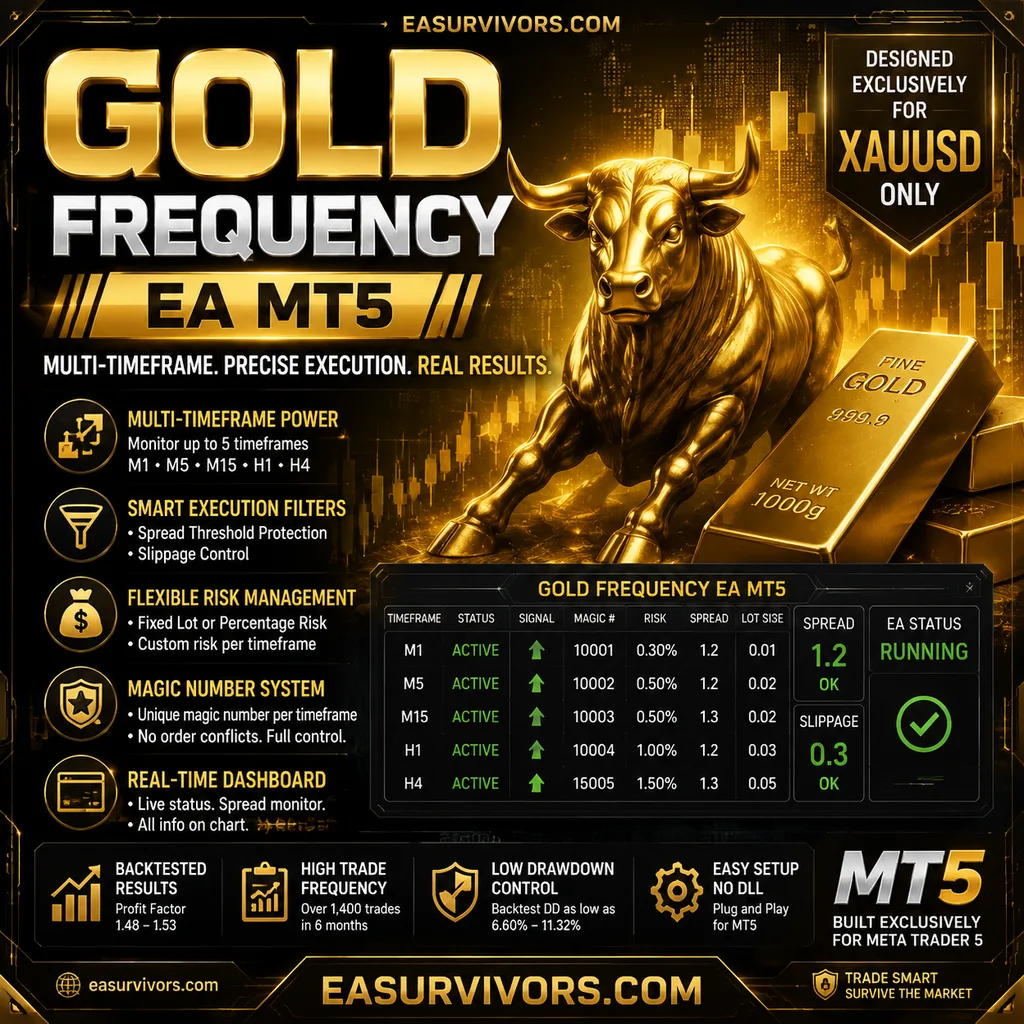
An automated Expert Advisor for MetaTrader 5 focused exclusively on XAUUSD, GOLD FREQUENCY EA monitors M1, M5, M15, H1 and H4 timeframes simultaneously, with each configurable independently. It combines spread and slippage filters, fixed or percentage-based position sizing, and a real-time status dashboard. Minimum recommended deposit is $1,000, with any account type and 1:100 leverage.

Losses on this strategy have no upper bound

The vendor's own description mentions position-scaling logic that keeps a losing sequence open instead of closing it. A single losing sequence therefore has no defined worst case: a long enough move in one direction takes the account to zero. Systems like this can trade profitably for a long time before that happens, which is why an unbroken track record does not settle the question.

Mechanisms found Martingale

How we classify loss mechanisms

GOLD FREQUENCY EA MT5
Instruments
XAUUSD (Gold)
Timeframe
M1, M5, M15, H1, H4
Minimum deposit
$1,000

Backtest results

Simulation — not a live account

Run in the MetaTrader Strategy Tester on real tick data. These are simulated results: a backtest shows how a strategy would have behaved on past prices, not how it will behave on your account.

Period Return Max drawdown Trades Win rate Profit factor
2025 May–Nov 6 months +0.1% −0.5% 985 27.7% 1.01
Equity curve — 2025 May–Nov Started at $100,000, ended at $100,046. Deepest drawdown −0.5%. Account balance Drawdown from peak 2025-05-01 → 2025-11-01
$100,046 -0.5% 2025-05-01 2025-10-31

Where the money went

MetaTrader reports gross profit and gross loss with broker charges already applied. Vendor pages quote the gross profit figure on its own.

Gross profit
$3,300.88
Gross loss
−$3,254.54
Net profit
$46.34

Already included above: $59.65 of commission and swap charged by the broker — 1.8% of gross profit.

How concentrated the profit is

80% of the profit came from 1 of 132 trading days (0.8%).

A smooth equity curve can still be a handful of exceptional days plus a long flat stretch.

Longest losing streak: 28 trades

Full test statistics

Every figure below is copied from the MetaTrader report exactly as it appears there, so you can check it against your own run.

Trade counts

Total trades
985
Total deals
1970
Long trades (won %)
959 (26.49%)
Short trades (won %)
26 (73.08%)
Winning trades
273 (27.72%)
Losing trades
712 (72.28%)

Best and worst single trades

Largest win
110.31
Largest loss
-37.88
Average win
12.09
Average loss
-4.57

Winning and losing streaks

Longest winning streak
5 (71.08)
Longest losing streak Consecutive losing trades, and what that streak cost. This is what you would have had to sit through.
28 (-162.18)
Biggest run-up
121.29 (2)
Biggest run-down
-162.18 (28)
Average winning streak
1
Average losing streak
4

Drawdown

Balance drawdown, absolute
424.95
Balance drawdown, maximal
498.71 (0.50%)
Balance drawdown, relative
0.50% (498.71)
Equity drawdown, absolute
427.55
Equity drawdown, maximal Measured on floating equity, not closed balance. Always the harsher of the two, and the one that triggers a margin call.
505.90 (0.51%)
Equity drawdown, relative
0.51% (505.90)

Risk and efficiency ratios

Profit factor
1.01
Expected payoff per trade Average result of one trade. A big number with a low win rate means it depends on rare large wins.
0.05
Recovery factor Net profit divided by the worst drawdown. Below 1 means the deepest hole was bigger than everything it made.
0.09
Sharpe ratio
0.36
Margin level How close the account came to a margin call. The lower it got, the less room there was for one more losing position.
501030.84%
AHPR
1.0000 (0.00%)
GHPR
1.0000 (0.00%)
LR correlation
-0.29
LR standard error
117.17

Holding time

Shortest position held
0:00:01
Longest position held
74:26:41
Average position held
1:24:47
Correlation (profit, MFE)
0.71
Correlation (profit, MAE) How strongly the eventual profit tracked the worst unrealised loss along the way.
0.47
Correlation (MFE, MAE)
-0.0235

Data quality

Trading server
BlueberryMarkets-Demo
Modelling quality
100%
Bars tested
12102
Ticks tested
78103049
Expert advisor settings used (20 parameters)

The exact parameters this test ran with, taken from the report. Results are only comparable when the settings are.

InpLotSize
0.01
InpMagicBase
900000
InpDeviationPts
30
InpMaxSpreadPts
500
InpUseRiskPercent
false
InpRiskPercent
1.0
InpRiskUseEquity
false
InpMaxLotCap
0.0
InpShowChartObjects
true
InpBlinkDurationMs
1200
InpBlinkIntervalMs
200
InpPanelCorner
0
InpPanelX
12
InpPanelY
25
ShowBackground
true
InpM1_Enable
true
InpM5_Enable
true
InpM15_Enable
true
InpH1_Enable
true
InpH4_Enable
true

How this was tested

Broker
Blueberry Markets Pty Ltd
Trading server
BlueberryMarkets-Demo
Symbol
XAUUSD.cn
Timeframe
M15
Starting balance
$100,000
Leverage
1:500
Tick data
100% modelling quality
Spread
Real variable spread

We ran this one in the same test as the rest of the list — including the ones that did not make the ranking: We backtested 19 expert advisors through the 2025 gold squeeze. 2 came through.

Specifications

Account type Any
Minimum leverage 1:100″
License type NoDLL

Screenshots

Description

Why Another Gold Robot Deserves Scrutiny

The market for XAUUSD automation is crowded with systems that promise consistent results while hiding a single-timeframe logic that breaks under changing conditions. Many rely on one chart interval, produce signals that contradict each other across timeframes, or struggle to manage order identification when multiple strategies run in parallel. GOLD FREQUENCY EA MT5 addresses these structural issues directly. It is built solely for MetaTrader 5 and trades only gold, but its core design is about coordinating different market perspectives rather than stacking indicators on a single view.

The EA can monitor up to five timeframes at once: M1, M5, M15, H1 and H4. Each timeframe functions as an independent signal source with its own activation switch, meaning a trader can run a scalping profile during active sessions, a swing profile on higher intervals, or any combination without opening separate charts. This multi-timeframe approach does not guarantee better entries—no system does—but it removes the ambiguity that occurs when a short-term signal conflicts with a longer-term context. The EA does not merge signals into a single vote. It trades each enabled timeframe separately, with unique magic numbers keeping positions distinct.

Execution Filters and Position Sizing Mechanics

The EA's order handling includes two explicit filters that many retail systems ignore. A spread threshold prevents new entries when the bid-ask gap exceeds a user-defined limit, which matters for gold because spreads can widen sharply during rollover or high-impact news. A slippage control sets a maximum acceptable deviation for order execution. These are not profit features; they are conditions that reduce the chance of entering a trade at a materially worse price than the signal assumed.

Money management offers two modes. Fixed lot trading keeps position size constant regardless of account equity, which is predictable but does not adjust for drawdown. The percentage risk mode calculates lot size from the configured account risk per trade, so a losing streak reduces subsequent position sizes automatically. Both modes are standard, but the implementation allows each timeframe to carry its own risk setting. That detail matters: a scalping signal on M1 can use a smaller percentage than a swing signal on H4, preventing the high-frequency component from dominating portfolio risk.

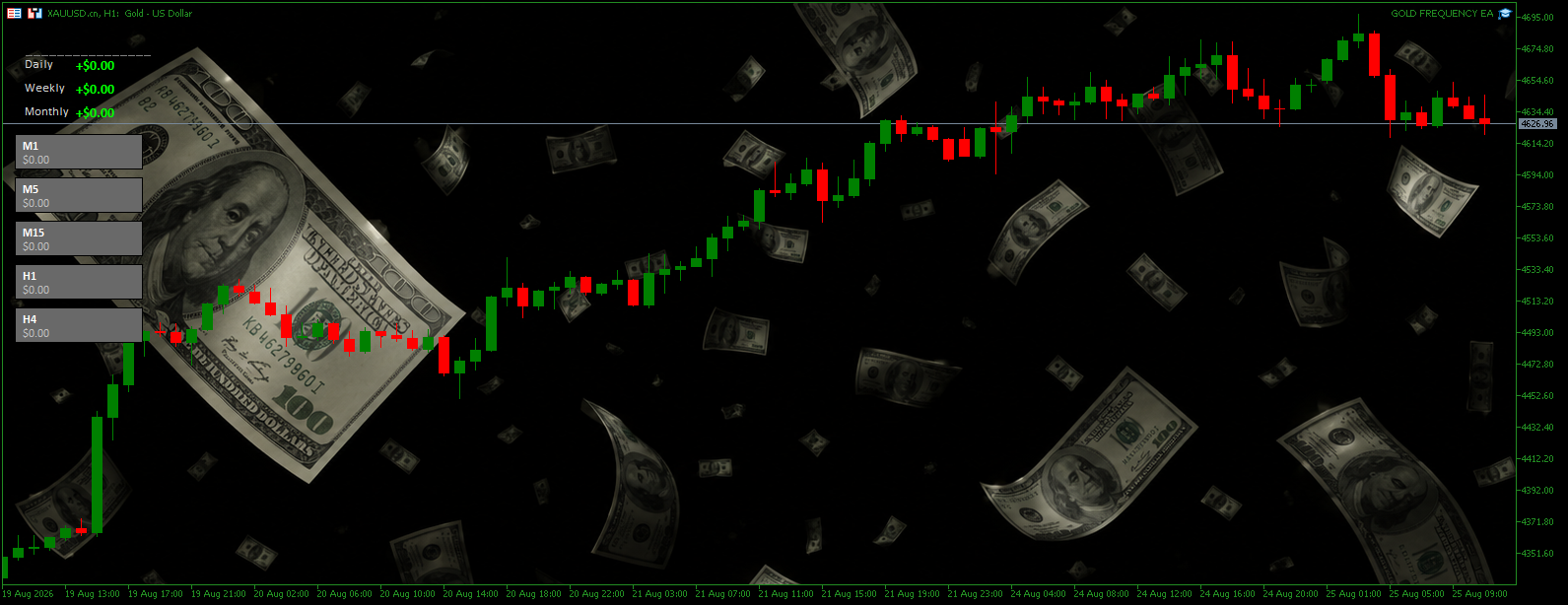
The dashboard panel is functional rather than decorative. It shows which timeframes are active, the current spread relative to the threshold, and the status of the EA. This is displayed directly on the chart without requiring separate indicator windows.

Magic Number System and Multi-Strategy Conflicts

A common failure mode for multi-strategy EAs is order collision. Two strategies running on the same symbol may attempt to close or modify the other's positions because they share a magic number or use an inconsistent numbering scheme. GOLD FREQUENCY EA MT5 assigns a distinct magic number offset to each enabled timeframe automatically. This means an order opened by the M5 logic cannot be accidentally closed by the H1 logic, and the user can inspect any position to see which timeframe generated it. For traders who run additional EAs on the same account, this reduces the risk of cross-system interference, though it does not eliminate all potential conflicts.

Installation, Inputs and Configuration

The product is delivered as a compiled file for MetaTrader 5 only; source code is not included. Installation follows the standard process of copying the .ex5 file into the MQL5/Experts folder and attaching it to an XAUUSD chart. The EA works on any of the five supported timeframes, but the active timeframe list is controlled through inputs, not the chart period. This means a trader can attach the EA to an M1 chart and enable only H1 and H4 signals, or attach to H1 and enable all five. The chart timeframe only affects the visual dashboard and the execution context if the user chooses a timeframe that is not in the enabled list.

Key inputs include enabling each timeframe separately, selecting fixed lot or percentage risk mode, setting the risk percentage, defining the spread and slippage thresholds, and adjusting dashboard position. There is no DLL dependency, which simplifies installation on restricted VPS environments and reduces the chance of compatibility errors after MT5 updates. The EA does not require external indicators or data feeds.

Realistic Expectations and Backtest Context

The vendor provides backtest examples, and these should be read as what they are: historical simulations with assumptions that may not hold in live trading. One reported test over six months on an M1 chart starting with $1,000 produced a net profit of $2,330.15 with a relative drawdown of 6.60%. Another test over a similar period starting with $2,000 produced $14,177.30 in net profit with a relative drawdown of 11.32%. These figures come from the vendor's own testing, and the developer reports a profit factor between 1.48 and 1.53. No independent verification is provided.

What these numbers indicate is that the EA is capable of executing a high number of trades—over 1,400 in six months in the first example—and that drawdown figures in backtests can stay in the single or low double digits. A trader running this live should expect different results. Slippage, spread widening, requotes, and the time gap between backtest tick data and live feed all affect execution. The spread and slippage filters are designed to mitigate some of this, but they cannot prevent it.

The minimum recommended deposit is $1,000. That figure is not a guarantee of safety; it is the base capital level at which the percentage risk mode can calculate reasonable lot sizes without hitting the broker's minimum volume. An experienced trader should model their own drawdown tolerance and reduce risk per trade accordingly. The EA is compatible with any account type, including prop-firm accounts, as long as MetaTrader 5 is available and the symbol specification matches. The 1:100 leverage spec does not limit the EA; it uses whatever leverage the account provides.

GOLD FREQUENCY EA MT5 is best suited for traders who want to automate gold trading across multiple timeframes with explicit control over execution filters and position sizing. It is not a set-and-forget system that profits without oversight. The user must decide which timeframes to enable, what risk level is acceptable, and whether the spread and slippage settings reflect current market conditions. Those decisions, not the EA itself, determine the outcome.
Frequently asked questions

Can I run all five timeframes simultaneously on a single chart?

Yes. The EA can have M1, M5, M15, H1 and H4 all enabled at once, and each timeframe operates as an independent signal source with its own magic number. You can also enable only a subset if you prefer a slower or faster trading style.

Does the EA use martingale, grid, or averaging?

The vendor description does not mention martingale, grid, or averaging logic. The EA appears to place individual trades based on timeframe signals with fixed or percentage-based lot sizing, and no recovery or compounding mechanism is described.

What happens when multiple timeframes generate signals at the same time?

Each enabled timeframe operates independently. If two timeframes both produce a valid signal, the EA may open two separate positions, each tagged with a unique magic number. The percentage risk mode applies to each trade individually, so total exposure can be higher than a single timeframe's risk.

Is the source code included or can I modify the EA?

No source code is provided. The product is delivered as a compiled .ex5 file, and the vendor explicitly indicates that the trading logic cannot be modified. All user customization is done through the input parameters.

Does it work on a prop firm account?

The EA is compatible with any MetaTrader 5 account that supports XAUUSD trading, including prop firm accounts. However, you must check the prop firm's rules regarding automated trading, maximum lot size, and drawdown limits, and configure the EA's risk settings accordingly.

Tags

Scalping Robot Pro MT5
Expert Advisor · MT5 XAUUSD (Gold)

Scalping Robot Pro MT5

A fully automated expert advisor built for one task: scalping spot gold on the one-minute chart. It filters trades through volatility, spread, tick activity, and scheduled sessions rather than opening on every candle, and it supports flexible risk settings across many account types. Scalping Robot Pro MT5 is aimed at traders who want systematic XAUUSD entries without manual chart monitoring.

No loss cap Martingale
M1 (1 minute chart) Minimum deposit $1,000
Volume Scalper EA MT4
Expert Advisor · MT4 XAUUSD (Gold), GBPUSD, EURUSD (Any)

Volume Scalper EA MT4

A volume-based breakout scalper for MetaTrader 4 that targets liquidity zones on XAUUSD, GBPUSD, and EURUSD. The EA combines tick volume analysis, volatility channel filtering, and tight stop-loss management for intraday entries on M1 to H1 timeframes. Designed for traders seeking systematic scalping with defined risk parameters on ECN accounts, this product operates with a minimum deposit of $1,000 and 1:100 leverage.

Loss capped
M1, M5, M15, H1 Minimum deposit $1,000