Why a dedicated gold scalper exists
Most automated strategies applied to gold fail because the instrument's volatility profile differs sharply from currency pairs. A system built around slow trend extensions can leave substantial unrealised profits on the table, or worse, give back gains when momentum reverses. This EA takes the opposite approach: it is engineered to capture a portion of a breakout move and close the position before the impulse fades. The developer positions it as a companion to a longer-term gold system, addressing the gap between structural entry and faster profit realisation.
The EA is restricted to XAUUSD. No other symbols are traded. This single-instrument focus means the internal logic can be tuned to gold's specific intraday ranges and spread behaviour, rather than relying on generic parameters stretched across multiple pairs. It also means the user must accept that diversification across instruments is not part of the design.
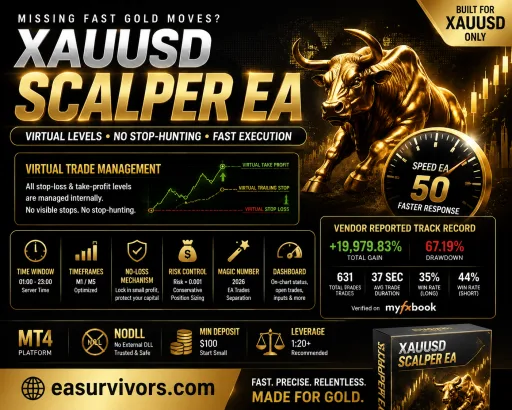
The vendor states the system does not use grid or martingale methods. Every order carries an individual stop loss. Position size is calculated as a percentage of account equity, which keeps exposure proportional to the current balance. A spread filter is built in to avoid entries when gold's typical spread widens beyond a threshold, a practical safeguard during rollover or high-impact news.
How the breakout logic operates in practice
The core signal is structural breakout detection based on price action, not indicator crossovers. The EA places pending orders at levels derived from recent price structure. When price breaks through a predefined boundary, the pending order is activated. Using pending orders rather than market orders aims to reduce slippage and ensure the entry is executed at the intended price level.
After entry, a dynamic stop loss, take profit, and trailing stop are applied. These are not fixed values. The EA adjusts them according to gold's current trading range and volatility. In low-volatility sessions, targets and stops are tighter; in expansion phases, they widen. The trailing stop is intended to lock in gains as the market moves in the trade's direction, while still allowing room for normal retracements.
One important caveat: the profitability of such a system depends heavily on the execution environment. Pending orders can be filled at worse prices during fast moves, and gold's spread can vary widely between brokers and account types. The EA's built-in spread filter mitigates this, but it does not eliminate it. A trader using a broker with unusually wide gold spreads will see different results than the vendor's backtests suggest.
Configuring the EA on MetaTrader 5
Installation follows the standard procedure for MT5 expert advisors: copy the compiled file into the MQL5/Experts directory, restart the terminal or refresh the Navigator, and drag the EA onto a XAUUSD chart. The timeframe is flexible; the vendor states the system works on any timeframe, which implies the internal logic adapts to the chart period rather than being optimised for a single setting.
The main user inputs are risk percentage, spread filter threshold, and the trailing stop sensitivity. The risk percentage controls lot sizing automatically. The developer recommends a minimum deposit of $100, but with any leverage at or above 1:30. On a $100 account with 1:30 leverage, the maximum position size is limited, and the risk percentage must be selected carefully to avoid overly small positions that are eroded by spreads and commissions.
Because the EA places pending orders and manages open positions, it must be left running on a chart or on a VPS for continuous operation. If the terminal is closed, no monitoring or exit management occurs. This is standard for EAs, but it is particularly relevant for a strategy that relies on quick trailing stops and adaptive exits.
Input parameters worth reviewing before first use
- Risk percent: sets the lot size for each trade relative to current equity. A value of 0.5 to 1 percent is a common starting point, though the developer does not publish a recommended setting.
- Spread filter: prevents new entries when the spread exceeds a user-defined level. The correct value depends on the broker's typical XAUUSD spread.
- Trailing stop sensitivity: controls how closely the stop follows price. Too tight and positions are stopped out by noise; too loose and more profit is returned before the exit.
- Maximum spread for exit: some configurations allow the EA to close positions only when the spread is below a threshold, avoiding costly exits during illiquid moments.
Realistic expectations for a sceptical user
The vendor marketing includes impressive live signal statistics: one account grew 175 percent in 22 weeks from a $400 deposit, and another grew 135 percent in 19 weeks from $500. These are vendor-reported figures. They are not independently audited and may reflect a specific market window favourable to breakout scalping. The same source notes drawdowns of roughly 15 percent, which is moderate for a gold-focused system but still means a $100 account could see an equity dip of around $15. A trader must decide whether that is acceptable given the account size.
Backtest results shown by the vendor are even more dramatic, but backtests of gold breakout systems are notoriously sensitive to tick data quality, spread modelling, and the period chosen. A 99 percent history quality does not guarantee future performance. The EA's aggressive configuration backtest from a $200 initial deposit is best treated as a stress test of the logic, not a projection.
No grid, no martingale, and no averaging mean the equity curve should not exhibit the long flat periods followed by sudden large losses typical of those approaches. However, breakout systems can have strings of small losses when gold ranges instead of trending. The adaptive parameters are meant to reduce this, but they cannot prevent it entirely.
Since the source code is not included, users cannot modify the core logic. The EA comes with an original version license, which typically allows use on a limited number of accounts. Buyers should verify the license terms before purchase, especially if they intend to run it on multiple terminals or prop firm accounts.