What the EA Actually Does
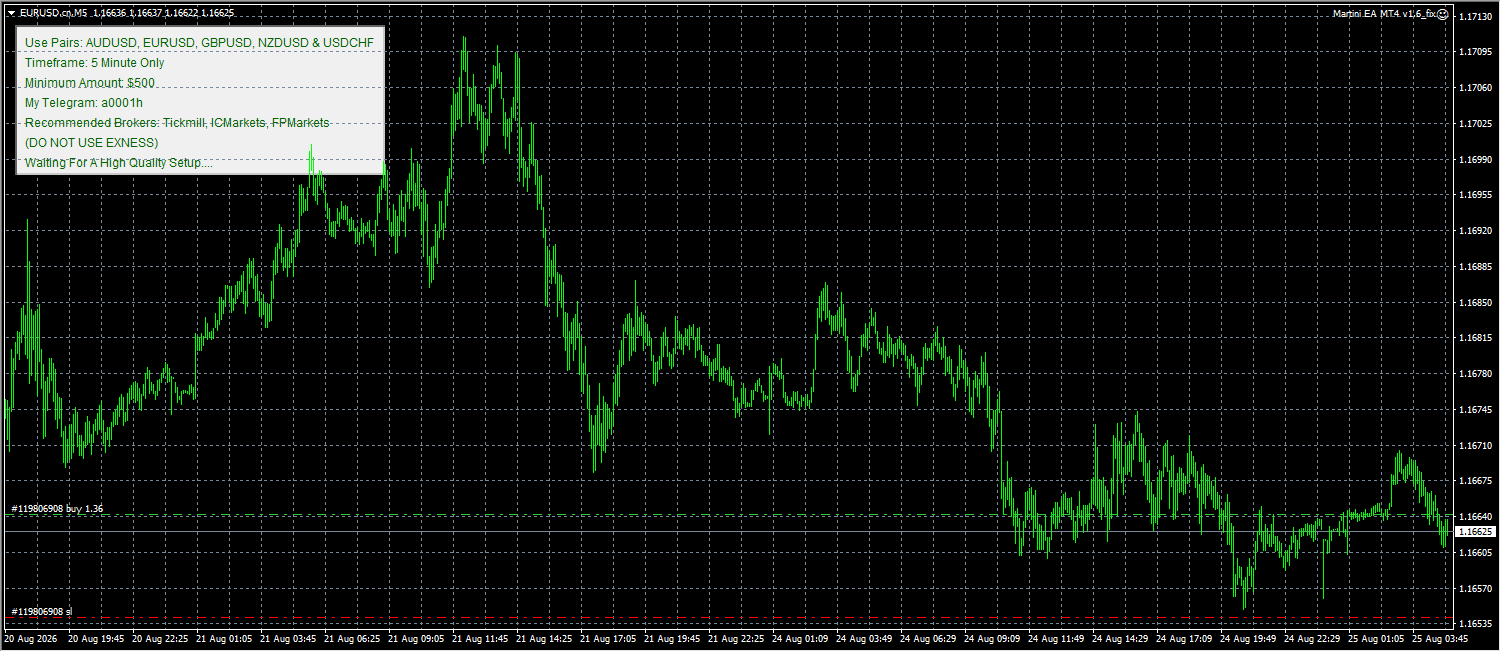
Scepticism is a reasonable starting point with any high-priced expert advisor. Martini EA MT4 is a scalping tool built for MetaTrader 4 that trades five specific pairs: GBPUSD, AUDUSD, EURUSD, NZDUSD and USDCHF. The developer has optimised it for the M5 timeframe, and the core idea is straightforward. Instead of chasing volatility, the EA waits for the low-volume periods between major sessions, then uses pending orders to enter positions at pre-defined levels. This nightly focus is meant to reduce exposure to news-driven spikes and erratic price action. Trades are closed quickly, typically within minutes, which places it firmly in the scalping category rather than trend-following or swing trading. The compiled binary includes hidden profit-booking logic, a feature rather unusual in overnight scalpers, which attempts to lock in open gains before the session ends.
There is no source code included, and the licence is fixed to a single account with no DLL calls. That matters if you intend to run it on a prop-firm account or a rented VPS, because moving it to another platform is not possible. The vendor sells Martini EA MT4 for $599, and the package contains the main executable plus separate .set files for each pair. You load the set file that matches the chart you attach it to.
Strategy in Practice
The strategy is deceptively simple, but the constraints are specific. Because it trades the M5 chart, the EA is checking for entries every five minutes during its active window. The exact trading hours are embedded in the settings and can be reviewed on the chart. The developer states that the EA is built to avoid high-impact news releases and low-liquidity trap periods. In practice, this means the bulk of its activity happens after the New York close and before the Tokyo open, or during the quiet midday stretch in Europe. It does not open trades on weekends and will typically flatten all positions before the next major session begins.
Pending orders are the execution mechanism, not market orders. The EA places limit or stop orders just beyond recent short-term ranges, aiming to catch small breakout attempts that occur during consolidation. Because volume is thin, these breakouts can be sharp but short-lived. The hidden profit booking feature is designed to cash in a portion of unrealised profit before the breakout attempt fully resolves. This is the kind of mechanism that helps an EA show a smoother equity curve on a backtest, but it also means individual trade profits are often small — a few pips at most. The win rate must be high enough to overcome spreads and slippage. On a standard account, this can be a challenge. The vendor does not specify spread limits or commission assumptions in the marketing text, so the actual execution environment matters more than usual for this EA.
Pair Selection and Set Files
The choice of pairs is deliberate. GBPUSD, AUDUSD, EURUSD, NZDUSD and USDCHF all have relatively tight spreads on most ECN accounts, and their nightly ranges tend to be compressed compared with yen crosses or gold. The included set files are named by pair, which means the EA is not one-size-fits-all. You are expected to run five separate charts, each with its own set file loaded. Running multiple charts on the same account requires a clear understanding of how the EA manages shared profits, position sizing, and drawdown limits. The vendor does not publish detailed money-management rules in the source copy, so you will need to inspect the input parameters yourself after installation.
Installation and Configuration
The installation package contains one .ex4 file and five .set files. There are no DLL libraries or external indicator files, which keeps the setup straightforward: copy the EA into the MQL4/Experts folder, restart the terminal, and attach it to a chart. The .set files go in the MQL4/Presets folder. Select the correct set file for the pair you are trading — loading a GBPUSD set file onto an AUDUSD chart will likely produce unintended results.
On-chart instructions and screenshots are advertised, so after you attach the EA you will see comments with guidance. The "NoDLL / Fix" licence means the EA is bound to your account number at activation, which is typical for commercial products. There is no source code to edit, which is a clear limitation for anyone who wants to audit the logic or make personal modifications. The vendor has not published the full input list in the marketing material, but scalping EAs of this type usually expose parameters for lot sizing, maximum spread, trading hours, and stop-loss distances. You will need to review these against the set files to understand the default risk per trade.
Realistic Expectations
Any EA that claims consistent overnight scalping profits should be approached with careful scrutiny. The vendor cites MyFxBook and signal results, with figures like 264% total profit and monthly averages around 7%. Those numbers come from a live account, but they are not independently audited. Treat them as the developer's own reporting, not as a guarantee. Back-tests on an M5 chart are also sensitive to tick data quality and spread assumptions. The vendor says it was optimised with real tick data, which is a good sign, but it does not eliminate the risk of curve-fitting over a finite historical period.
With a $500 minimum deposit, the lot sizing must be extremely small for most pairs — micro lots or even smaller on a standard account. That is realistic, but the per-trade profit will be tiny in absolute terms. The EA's profitability depends on high execution precision and consistent low spreads, so an ECN raw-spread account is likely necessary. Commission is not mentioned anywhere in the published specs, and a scalper paying $7 per round turn per lot will need to clear a significant hurdle before it becomes net profitable. If you cannot get spreads below 1 pip on GBPUSD during active hours, this EA may struggle to break even. The best way to test it without throwing $599 at the unknown is to ask the vendor for detailed performance reports with commission and swap included, and to run a small demo forward test for at least one month before committing real funds.