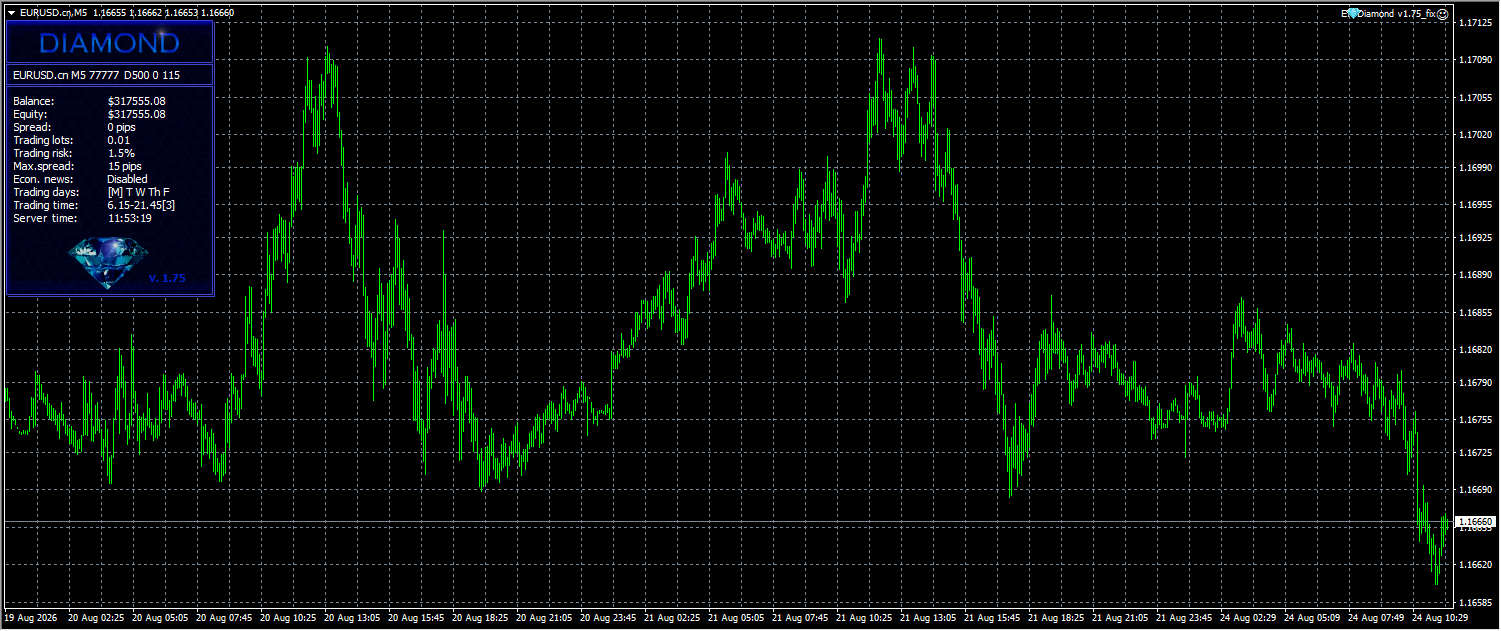
How the adaptive algorithm approaches the H1 chart
Scepticism about pre-built trading systems is usually healthy, especially when marketing copy promises that a single expert advisor can read price action, time of day, and upcoming economic releases all at once. EA Diamond MT4 is built around exactly that kind of multi-layer evaluation on three majors: EURUSD, GBPUSD and USDJPY. The logic is not a single indicator stack but a combination of adaptive rules inherited from several earlier commercial strategies. In practice this means entry signals are filtered by the day of the week, session timing and a news calendar layer that is supposed to step aside during red-label events.
The fixed H1 timeframe matters. The EA is not intended for M15 scalping or daily swing trading; it processes one bar per hour and holds positions for short periods, consistent with a scalping approach on a relatively slow timeframe. The developer provides preset files for each pair, which suggests the default behaviour is pair-specific rather than universal. A trader who prefers to modify risk, lot sizing or the news filter distance can do so from the input panel, but the packaged configuration is designed for minimal setup.
What the backtested track record really tells you
The vendor circulates a five-year backtest on USDJPY showing a net profit of roughly $11,700 from a $1,000 starting balance, a win rate near 85% and a maximum drawdown around 12%. Those are the vendor's own figures, not independently verified results, and they reflect a specific set of parameters over a particular historical window. A high win rate combined with modest drawdown often indicates a tendency to take small profits and leave occasional larger losses to the trailing stop, which is a plausible profile for an H1 scalping engine but not a guarantee of future behaviour.
Practical concerns are not swept under the rug. The system works with a minimum deposit of $200, but that is the floor, not a recommendation. With 1:30 leverage, a $200 account gives limited room for three simultaneous positions and the spread and slippage of a live ECN environment. The developer suggests starting with a demo or a small live account and observing how the news filter behaves around actual releases, because backtests often model news avoidance more cleanly than live execution allows.
Preset files and what each one changes
The package includes nine set files: three risk profiles for each of the three pairs. The R1.5 and R1.25 variants adjust the risk multiplier relative to a base level, while the SL set enables a fixed stop-loss instead of the default trailing logic. This is useful for a trader who wants to cap per-trade risk at a known pip distance, although it may reduce the reported win rate because some trades that would otherwise recover will be closed at a loss. No source code is provided, so parameter transparency is limited to what the developer exposes in the inputs. The licence is NoDLL / Fix, which means the EA runs without external library calls and the .ex4 file is fixed for the account on which it is activated.
Setting up without turning it into a black box
Installation follows the standard MT4 procedure: copy the .ex4 file into the Experts folder, place the .set files into Presets, then attach the EA to an H1 chart of EURUSD, GBPUSD or USDJPY. The preset matching your chosen pair must be loaded manually from the input dialog; the EA does not auto-select among the nine files. If your broker uses a suffix such as EURUSD.a, the symbol name in the EA must be adjusted or the EA will simply ignore the chart.
Because the strategy depends on time-of-day and day-of-week filters, the chart's time zone matters. The EA reads the server time of your broker, not your local time, so a preset that is tuned for a GMT+2 broker may behave differently on a GMT+3 server during daylight saving shifts. This is rarely mentioned in promotional materials but is one of the first things to verify when moving from a backtest to a live account.
Realistic expectations for a sceptical buyer
The strongest case for EA Diamond MT4 is not a promise of daily returns; it is the combination of a narrow scope — three pairs, one timeframe, preset configurations — and a news filter that is actually implemented rather than just advertised. A narrow scope is easier to validate than a system that claims to trade any instrument at any time. The developer also reports community feedback that mentions small steady gains and occasional double-digit drawdowns, which is consistent with the asymmetry of a scalping algorithm on H1 bars.
The weakest case is the absence of source code and the reliance on a fixed .ex4 file. That limits formal verification of the logic and ties the licence to a specific account environment. For a trader who accepts those limits, the sensible path is to run the EA on a demo or cent account for several weeks across different market conditions, intentionally including a major news week, before considering a funded account. The $200 minimum deposit is achievable, but with three pairs and preset lot multipliers, a more conservative starting balance gives the system room to absorb a sequence of losing trades without breaching the margin buffer.