Set-up and initial configuration
Alpha ATM Bot MT5 is distributed with set files, which means the core parameters for XAUUSD on the M1 timeframe are pre-loaded. After attaching the advisor to a gold chart, checking that automated trading is enabled and that the symbol suffix matches the broker's naming convention is the first practical step. The set files provide a reference configuration, but every input remains available for adjustment, so a trader can start with the vendor defaults and then scale position sizes or spacing to match account equity.
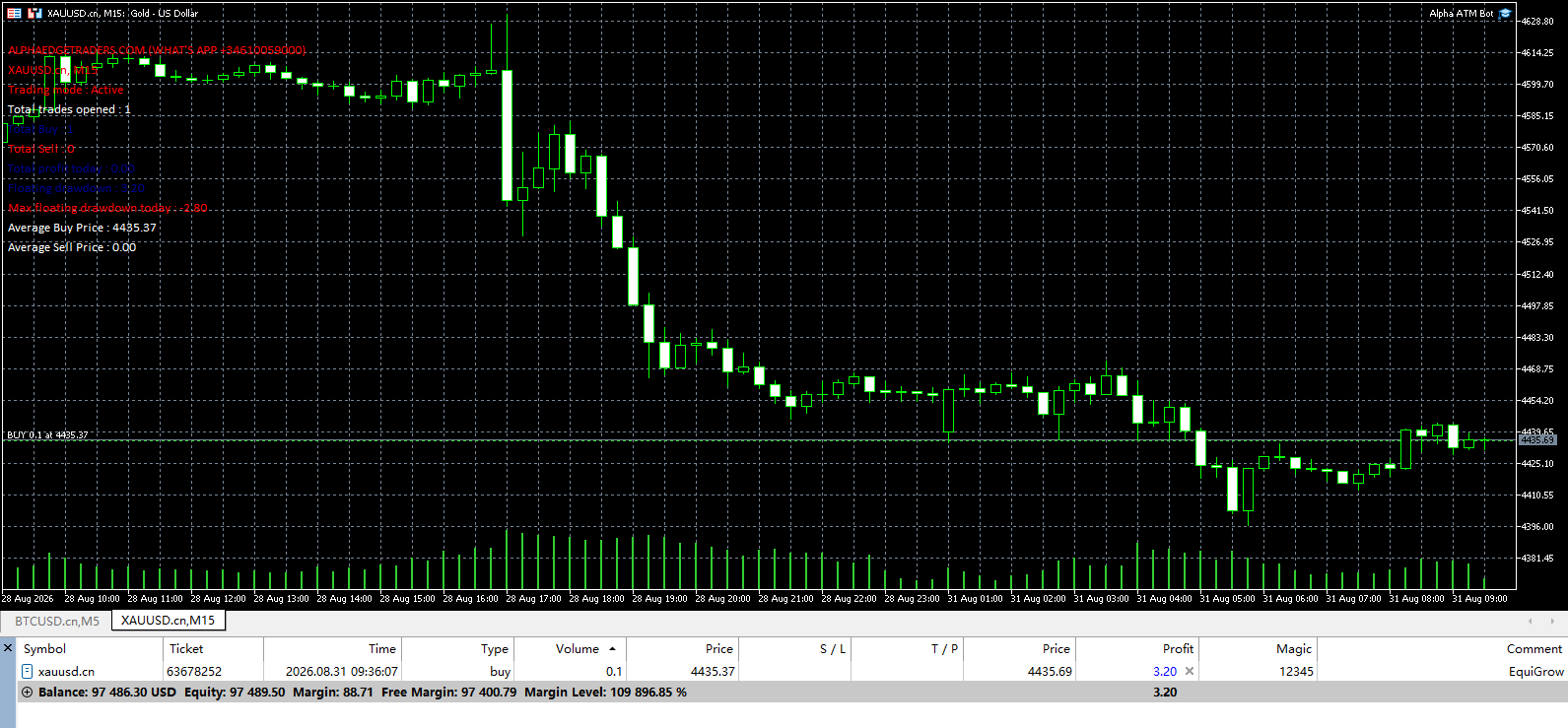
The dashboard appears on the chart once the EA starts and shows open positions, basket status, and any active filters. It is worth spending a few minutes understanding the dashboard before live deployment, because it is the main way to see what the EA is doing without digging into the journal.
How the ATM entry logic opens and closes trades
The EA monitors market conditions on the M1 gold chart and opens buy or sell trades according to its internal ATM mode. When a trade moves against the open position, the system can add further entries at configurable spacing. Each new position uses a lot multiplier that is defined by the user, and a maximum number of positions caps the basket size. This dynamic averaging approach is not a simple one-entry-per-signal strategy; rather, it builds exposure gradually within user-set boundaries.
Closing is handled in two ways. A trailing stop can lock in profit once a configurable start level is reached, moving in adjustable steps. Separately, a group take profit closes the entire basket together when the combined floating profit reaches the target. This dual exit mechanism means a single trade may be closed by the trailing function, while a basket of averaged positions is usually closed as a block.
The DCAM filter
A MACD-based filter, referred to in the documentation as DCAM, is designed to refine entries and exits. It uses standard MACD settings of 12, 26, and 9, and can be set to confirm trade entries, close profitable positions, or reject low-quality signals. The filter is optional, and traders who prefer raw ATM mode can switch it off. When enabled, it adds a momentum check before the EA commits to a new position, which can reduce the number of trades taken during flat or choppy conditions.
Risk controls and account protection
Position sizing starts with an initial lot that the trader defines. From there, every subsequent addition uses the chosen multiplier, but a hard maximum lot stops the sequence from escalating indefinitely. Daily loss limits and daily profit targets act as account-level circuit breakers. If the daily drawdown limit is hit, the EA stops opening new positions until the next trading day; if the daily profit target is reached, it can stop trading early to preserve the session's gain.
Hedging is available but not mandatory. The EA can open an opposite position when drawdown reaches a specified level, or use pattern confirmation to decide when a hedge is appropriate. The hedge reduces net directional exposure during extended adverse moves. Because hedging is disabled by default in many set files, a trader must explicitly enable it and set the trigger thresholds before it will act.
Where the approach needs careful handling
The most sensitive settings are the entry gap, lot multiplier, and maximum positions. With a wide entry gap and a high multiplier, the basket can grow quickly in size, and the maximum positions cap is the only hard stop. A trader who sets this too high relative to account equity can see margin usage climb during a strong trend against the basket. The vendor's marketing materials mention that the strategy is designed for medium to high risk tolerance, which is consistent with the averaging and hedging mechanics. Traders who prefer a single position per signal with a fixed stop loss will find the default behaviour very different.
The EA works on the M1 timeframe, which means decisions are made constantly during the trading session. While this is typical for gold scalping and short-term averaging, it also means the EA is sensitive to spread changes and broker execution speed. The built-in economic calendar can filter high, medium, and low impact news events, which is a useful safeguard on gold, where macro releases can move price several dollars in seconds. Whatever the settings, a forward test on a demo account is a sensible step before committing real funds.