Product specifications
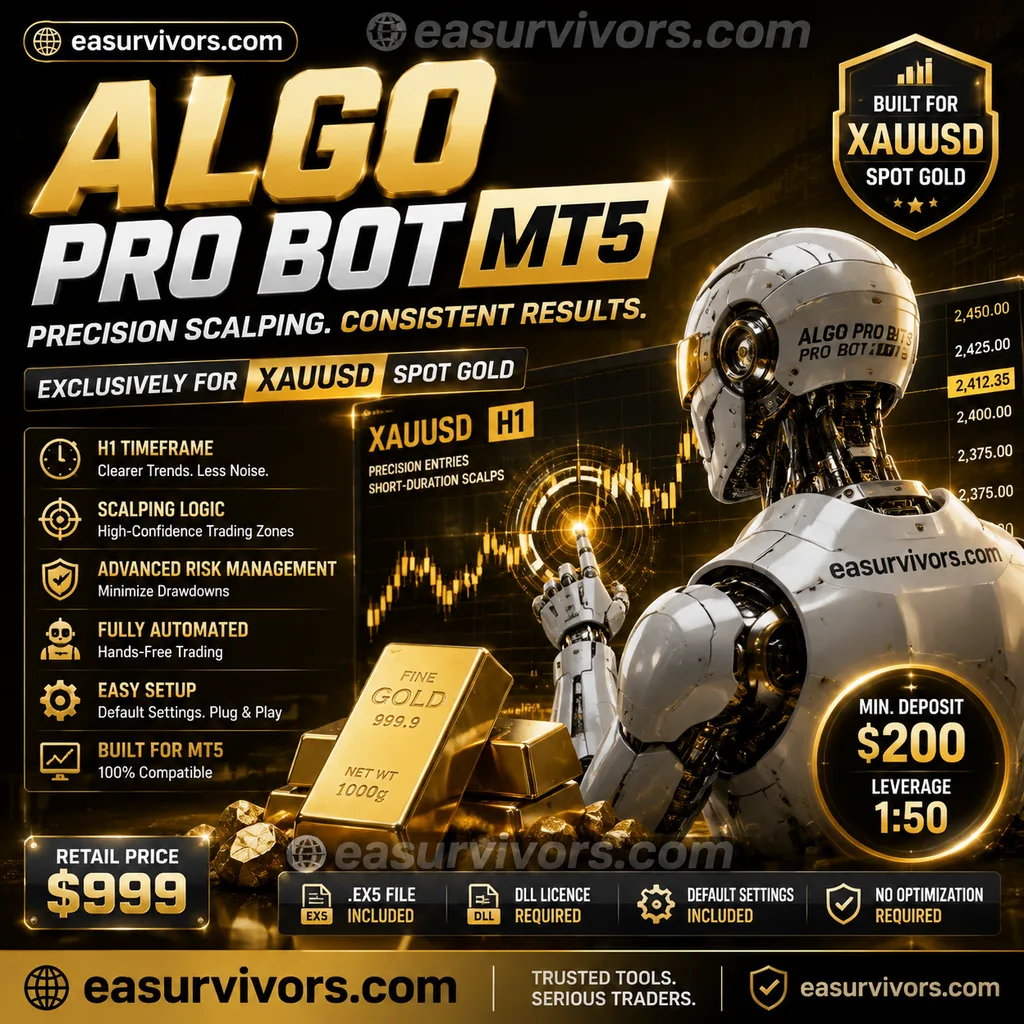
Algo Pro Bot MT5 runs exclusively on MetaTrader 5 and is built for a single market: XAUUSD, or spot gold. It operates on the H1 chart, which gives each candle a full hour to develop and filters out the noise of lower timeframes. The advertised minimum account balance is $200, with a suggested leverage of 1:50, though the developer states it will work on any account type.
The product ships as a compiled .ex5 file and requires a DLL licence. Source code is not included, so the internal trading logic cannot be inspected or modified. The retail price is $999, and the package contains the expert file along with default settings that are intended to work without further configuration.
Scalping logic on the hourly chart
The system is classified as a scalping strategy, although the H1 timeframe is slower than the M1 or M5 charts typically associated with scalp trading. Entries are based on the vendor's description of high-confidence trading zones where price volatility supports short-term positions. Each trade is intended to capture a small portion of a gold move and exit quickly, rather than holding for multi-hour swings.
Because gold can move sharply during London and New York sessions, the H1 timeframe provides a wider context for each entry. The developer states that the EA identifies areas of market volatility and executes orders when conditions align. The precise entry and exit rules are not disclosed beyond that description.
- Trading pair: XAUUSD only
- Chart timeframe: H1
- Order style: short-duration scalp trades
- Automation: fully automated execution
Risk control and exposure
The vendor mentions advanced risk management as one of the core features, with the stated goal of minimising drawdowns. Specific mechanisms are not published, but the use of a $200 minimum deposit on gold suggests that position sizing must be conservative, since a single standard lot of XAUUSD would exceed the recommended account size many times over. This implies the EA relies on small lot sizes or a built-in money management function.
No information is provided about stop-loss placement, take-profit targets, trailing stops, or a maximum number of concurrent positions. Any buyer running this EA on a live account should verify how the risk layer behaves on a demo first, particularly during high-impact news events when gold spreads widen and slippage increases.
Installation and setup notes
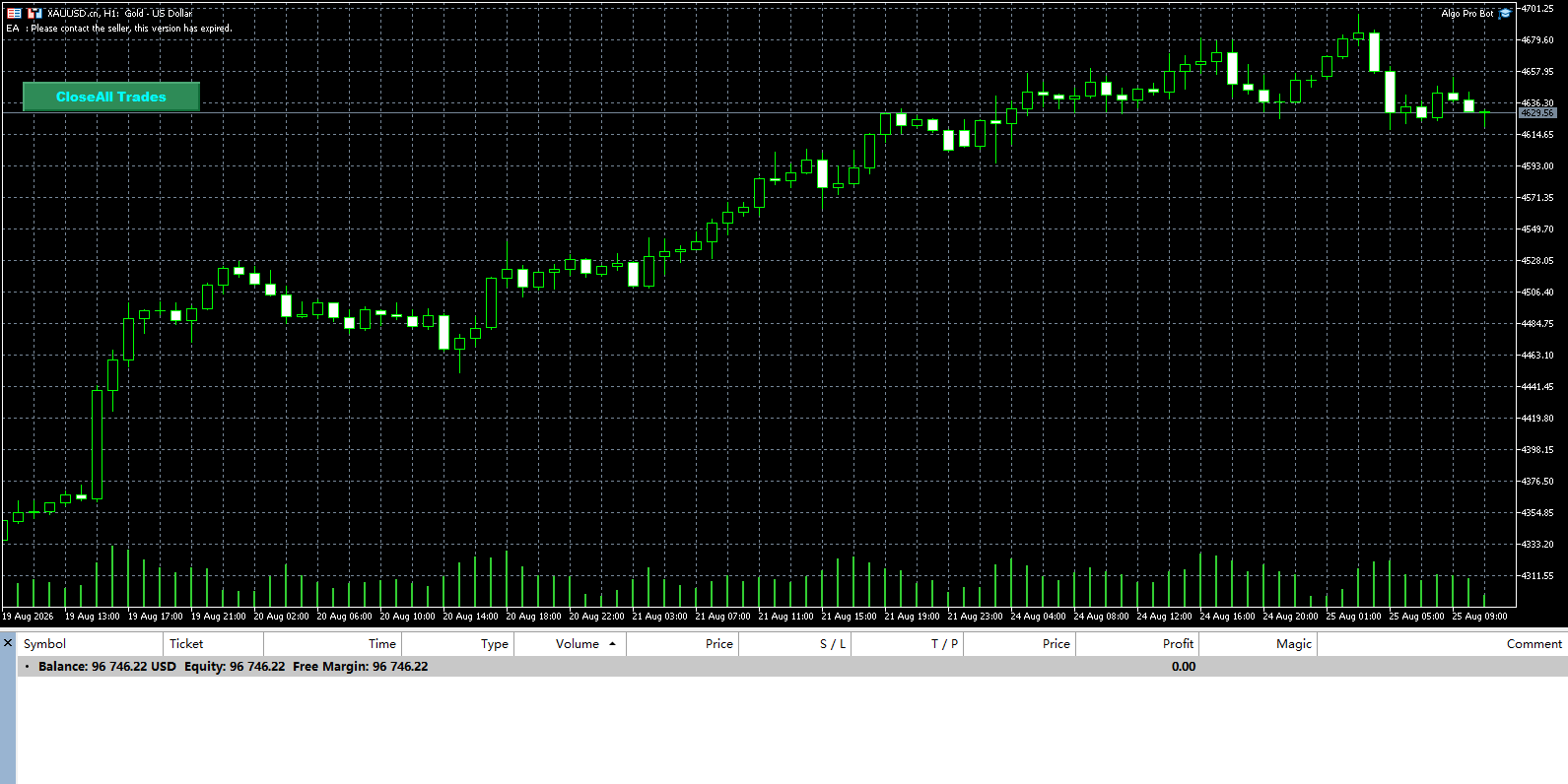
Setup is intended to be simple. The download contains the Algo Pro Bot.ex5 file, which must be placed in the MQL5/Experts folder of the MetaTrader 5 installation. After restarting the terminal, the EA is attached to an XAUUSD H1 chart with the default parameters loaded. The DLL licence means that the terminal must be set to allow DLL imports, otherwise the EA will not start.
Because there is only one supported symbol and timeframe, there is no need to maintain separate set files for different pairs. The developer states that the default configuration is sufficient for most users, and no optimisation is required before going live.
Account and leverage considerations
A minimum balance of $200 with 1:50 leverage provides limited margin for gold trading. At the time of writing, one standard lot of XAUUSD requires roughly $4,000 in margin at that leverage. The fact that the EA is marketed for a $200 account strongly suggests it uses a fraction of a lot, possibly a micro lot, and adjusts size based on available free margin. Traders should confirm this on a demo account before depositing real funds.
Before running it live
The marketing materials describe consistent long-term performance and impressive returns, but these figures are not independently documented on this page. The developer's own results should be treated as promotional information, not a guarantee of future behaviour. Gold is a volatile instrument, and a scalping EA that performs well in one market regime may behave differently during ranging or low-liquidity periods.
Testing on a demo account for several weeks, including around major economic releases, is a practical way to understand drawdown patterns and execution quality. Because the source code is not available, the EA cannot be audited for hidden risk, so the only way to evaluate it is through forward testing on a broker account with realistic spreads and commissions.