Installation and Initial Setup
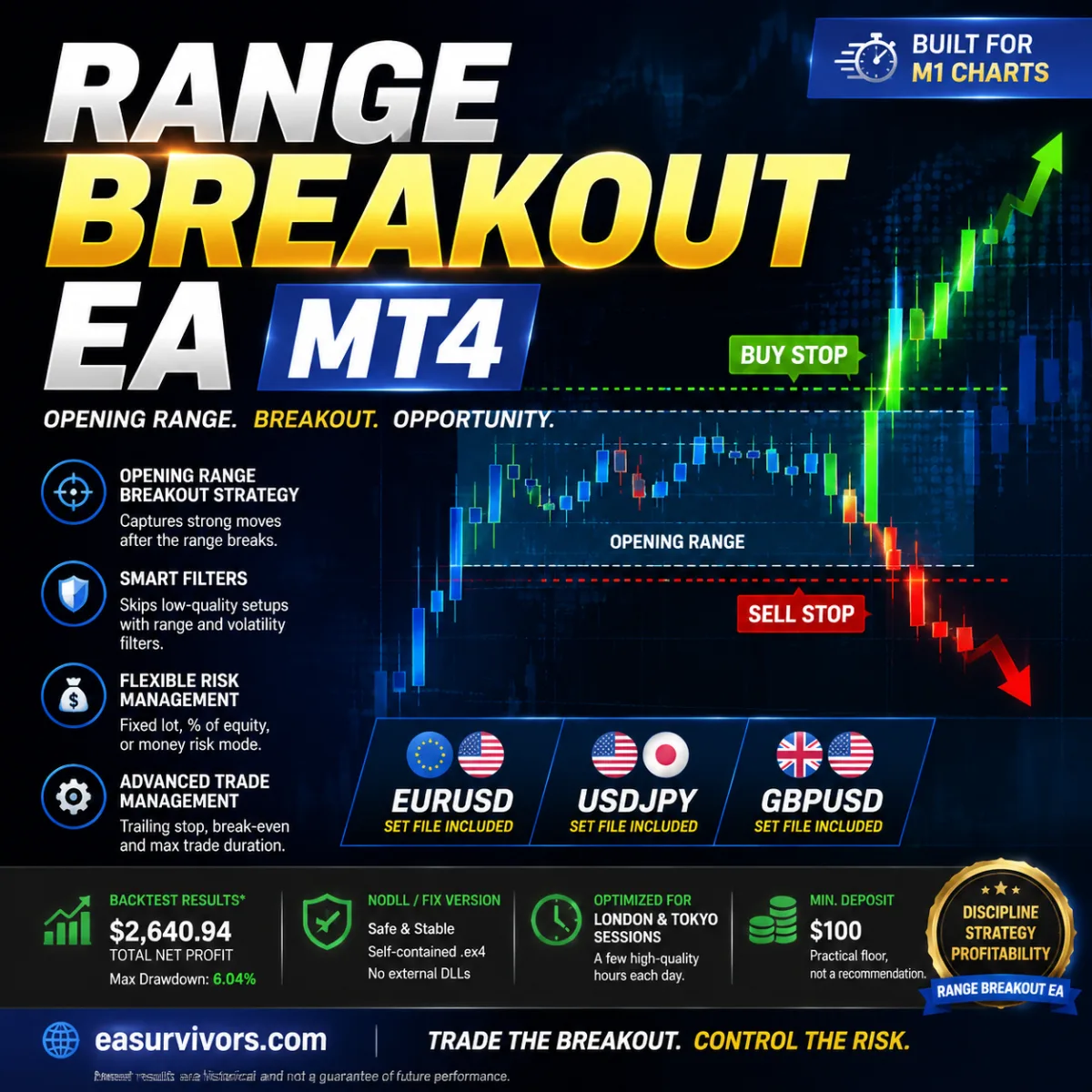
Before running the EA, verify that your MetaTrader 4 terminal is up to date and that you have a stable connection to your broker's server. The package includes the compiled expert file (an .ex4) and three set files, each tuned for a specific symbol on the M1 timeframe. Copy the expert file into the 'Experts' folder and the set files into the 'Presets' folder of your MT4 installation. After restarting the platform or refreshing the Navigator, attach the expert to a chart for the symbol you intend to trade. The included set files cover EURUSD, USDJPY, and GBPUSD, and they preconfigure the risk and session parameters for those instruments.
Because the EA is designed for breakout trading during defined market hours, the system clock and trading session settings on your broker's platform matter. The default parameters assume a specific time window for the opening range; if your broker's server time differs significantly from the local market open, you may need to adjust the input values accordingly. The set files are a practical starting point, but they are not a guarantee that the EA will perform identically on every account.
Order Entry and Exit Logic
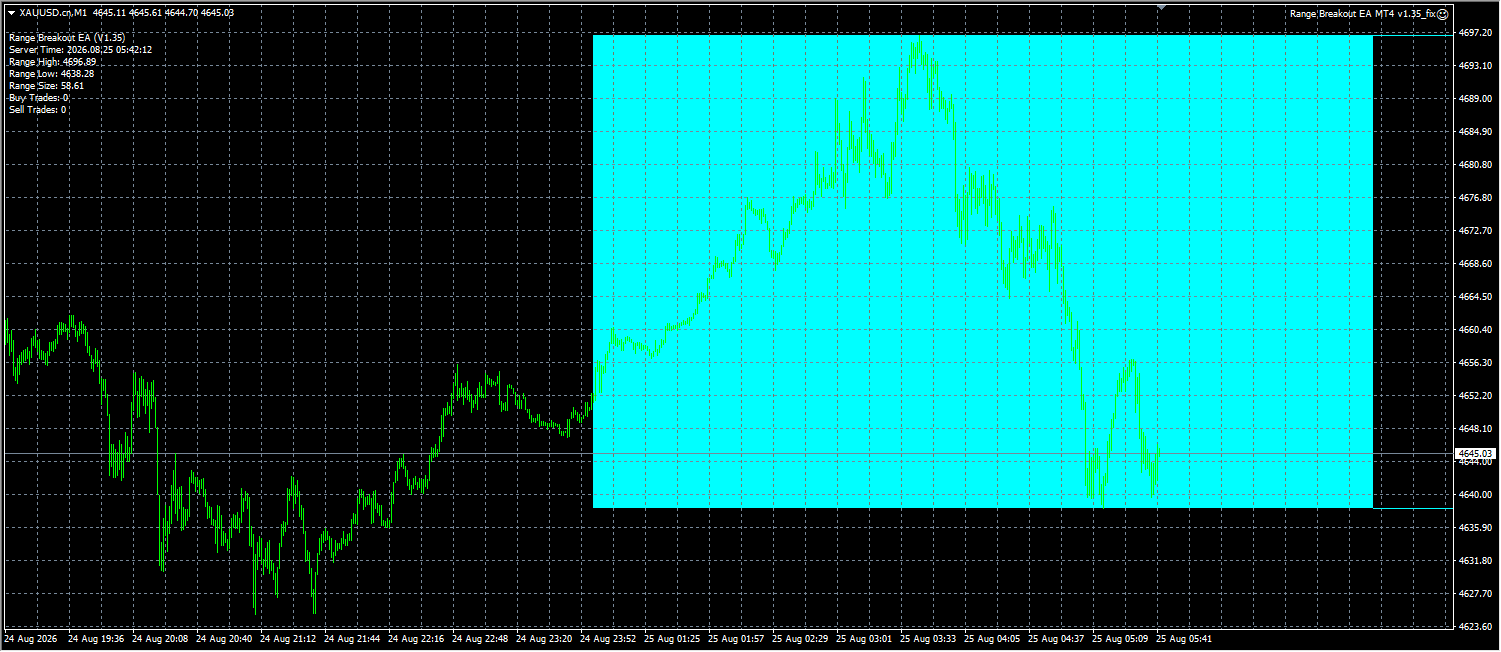
The EA's core concept is to measure a price range over an initial period and then place pending stop orders above and below that range. When the market breaks out, one of the orders is triggered and becomes a market position. This is a classic opening-range breakout approach, but with additional filters: the EA evaluates the height of the range and may skip trades when the range is too small or too large relative to recent volatility. This filtering is intended to avoid low-quality setups where a breakout might immediately reverse.
The EA does not use a martingale or grid approach. Each signal corresponds to a single entry, and the risk per trade is controlled by the lot-sizing mode you select. Exit management includes a trailing stop and a break-even function. Once the trade moves a certain distance in your favor, the stop loss can be adjusted to lock in profits. The EA also enforces a maximum trade duration; if a position has not reached its target or stop by a pre-set time, it is closed automatically.
Configuring Risk and Money Management
Risk allocation is adjustable through three modes: fixed lot, percentage of equity, or a monetary amount per trade. The set files provided by the developer typically use the automatic lot mode, where the position size is calculated from the account balance and the stop-loss distance. This helps keep the loss per trade relatively constant, but it also means that the absolute lot size will grow if the account grows. Traders who prefer maximum control can switch to fixed lots and set an explicit lot size that matches their comfort level.
The minimum suggested deposit is $100, but this is a practical floor, not a recommendation. At that level, with a fixed lot size of, for example, 0.01 lots on a major pair, the margin usage would be moderate, but a sequence of losing trades could still draw down a significant portion of the account. A larger buffer reduces the statistical likelihood that the EA will hit a drawdown limit before a profitable breakout sequence. The developer's own backtest used a $10,000 initial deposit, which allowed for more conservative position sizing and a reported maximum drawdown of about 6% over the test period.
Instrument and Timeframe Considerations
The EA is optimized for M1 charts, meaning it calculates the opening range from one-minute candles. Despite the short timeframe, the strategy is not a high-frequency scalper: it aims to capture directional moves that develop after the range is broken, often during the first hours of the London or Tokyo session. Therefore, the relevant opportunity window is usually a few hours per day per symbol.
Although the developer lists the three majors as the primary instruments, the EA can technically be attached to any symbol and timeframe. However, the range filters and session logic were calibrated for these specific pairs on M1. Using the EA on a different timeframe, such as M5 or M15, would change the meaning of the range and could produce different results. The same applies to non-listed pairs with different volatility profiles. For that reason, the set files should be used only on the symbols for which they were designed.
Practical Limitations and Failure Modes
A breakout strategy fails when breakouts are false, meaning the price moves beyond the range and then reverses. The EA's range-size filter is intended to reduce these failures, but it cannot eliminate them. On days with low volatility or during holiday periods, the EA may not trade at all because the range is too small to meet the filter criteria. Conversely, during major news releases, the range may be extremely wide and the EA may avoid trading altogether. This is not a flaw, but it means the EA's activity is concentrated in specific market conditions.
Another practical concern is the dependency on the specified trading window. If the opening range is defined by a fixed time, such as the start of the London session, then a shift in broker server time (e.g., due to daylight saving time differences between the broker and the actual market open) can move the range window and alter the signals. Users should check their broker's GMT offset and, if necessary, adjust the session input parameters. The license is a NoDLL/Fix version, meaning the expert does not rely on external DLL calls; it runs as a self-contained, compiled .ex4 file. Source code is not included, so the internal calculations cannot be modified or inspected by the buyer.
What the Backtest Data Show
The vendor provides a backtest summary from an initial deposit of $10,000, with a total net profit of $2,640.94 and a maximal drawdown of 6.04%. These figures are historical simulation results, not a forecast. The backtest presumably used the developer's recommended settings on one or more of the listed pairs. Such results are heavily dependent on the period tested, broker conditions (spread, slippage, and commission), and the quality of the tick data used. A live account may experience a different sequence of breakouts and a different drawdown profile.