Core specifications at a glance
This is a fully automated Expert Advisor for MetaTrader 5. It operates on the H1 timeframe and monitors five currency pairs simultaneously: EURUSD, AUDUSD, NZDUSD, EURGBP and AUDNZD. The vendor lists a minimum deposit of $100 and recommends RAW Spread or ECN accounts. Any leverage is accepted.
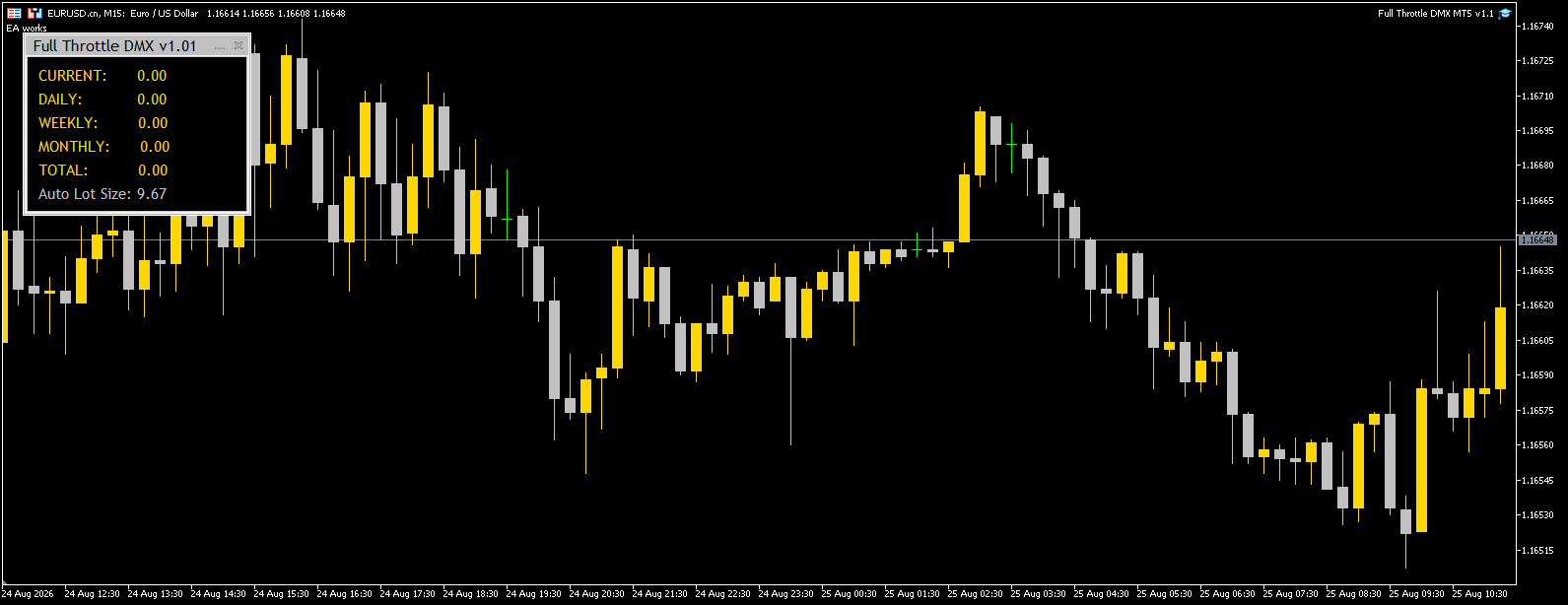
Full Throotle DMX MT5 runs ten independent strategies that rely on classical technical analysis. There is no grid, martingale, or averaging logic. Every position has a stop loss, and the EA manages exits with a trailing stop and take profit. The original licence is included, but the source code is not supplied.
How the ten strategies work together
The EA builds a diversified portfolio from a single chart. Each strategy applies its own logic to the five supported pairs, so the system can take trades in trends, momentum phases, and ranging conditions. Because the strategies are independent, losing streaks on one pair do not automatically trigger offsetting or recovery trades elsewhere.
The robot places at most one trade per symbol at a time. This keeps exposure simple and avoids the compounding risk of layered positions. The vendor describes the strategies as based on classical technical indicators and proven market logic, but does not publish the exact entry rules.
Risk controls: stops, sizing and filters
Every trade carries a fixed stop loss and take profit. A trailing stop is available to lock in favourable movement. Position sizing is controlled by an automatic lot calculation, with four selectable profiles: Fix Lot, Safe, Balanced, and Aggressive. These profiles let the user choose how aggressively the EA scales position size relative to account equity.
In addition to stops and sizing, the EA includes three execution filters. A news filter can pause trading around high-impact calendar events. A spread filter prevents entries when the spread is wider than a defined threshold. A slippage filter rejects orders when price movement between signal and execution would be too large. These filters work together to avoid poor entry conditions during volatile periods.
Prop firm and account suitability
The no-grid, no-martingale design and one-trade-per-symbol rule are intended to respect common prop firm guidelines. The developer states that the EA is suitable for funded account environments that require transparent logic and controlled drawdowns. Traders should still verify the specific rules of their prop firm before deployment.
Setup notes for live and demo trading
The EA is attached to one H1 chart in MetaTrader 5. It does not require multiple chart instances, because it manages all five pairs from a single running copy. Users must enable automated trading in the platform and allow access to the symbols in the Market Watch window.
For best execution, the vendor recommends a RAW Spread or ECN account. These account types typically offer tighter raw spreads, which improves the spread filter's behaviour. Leverage is not restricted, but higher leverage increases the effect of the chosen lot-sizing profile.
What to check before running it live
Start with a demo account and run the EA for at least several weeks. Because it trades on the H1 timeframe, signals are infrequent compared with scalping systems, so a longer observation period is needed to see how the ten strategies interact with real spreads and news events.
Compare the EA's behaviour on demo with a backtest using high-quality tick data. Pay attention to the spread and slippage filters, as demo accounts may not reflect live execution costs. Finally, choose the risk profile that matches your maximum acceptable drawdown before switching to a live account.