Who This System Is Designed For
This expert advisor is aimed at traders who want exposure to Bitcoin without manually watching charts, but who also do not want an algorithm firing market orders constantly. The design will appeal to anyone who prefers conditional entries over chasing price, and to those who want every trade to include break-even logic and a trailing stop from the outset. It is less suited to traders who expect high-frequency activity or who want to run it on multiple currency pairs; the focus here is deliberately narrow.
The profile fits a disciplined account holder running a Cent or ECN account with at least $1,000. The vendor positions the product for users who value a documented track record, though any performance figures need to be read with the usual caution around backtest and live account differences.
Avoiding Continuous Market Execution
The core behaviour is selectivity. Instead of opening market positions whenever a signal appears, the system waits for specific volatility conditions and then places pending orders at a distance from the current price. That means it will go through periods without a single trade if the market is flat or if volatility is outside the configured band. Traders who get nervous when an EA is idle may find this difficult to sit through, but that idleness is the point of the design.
Mechanics of the Trading Logic
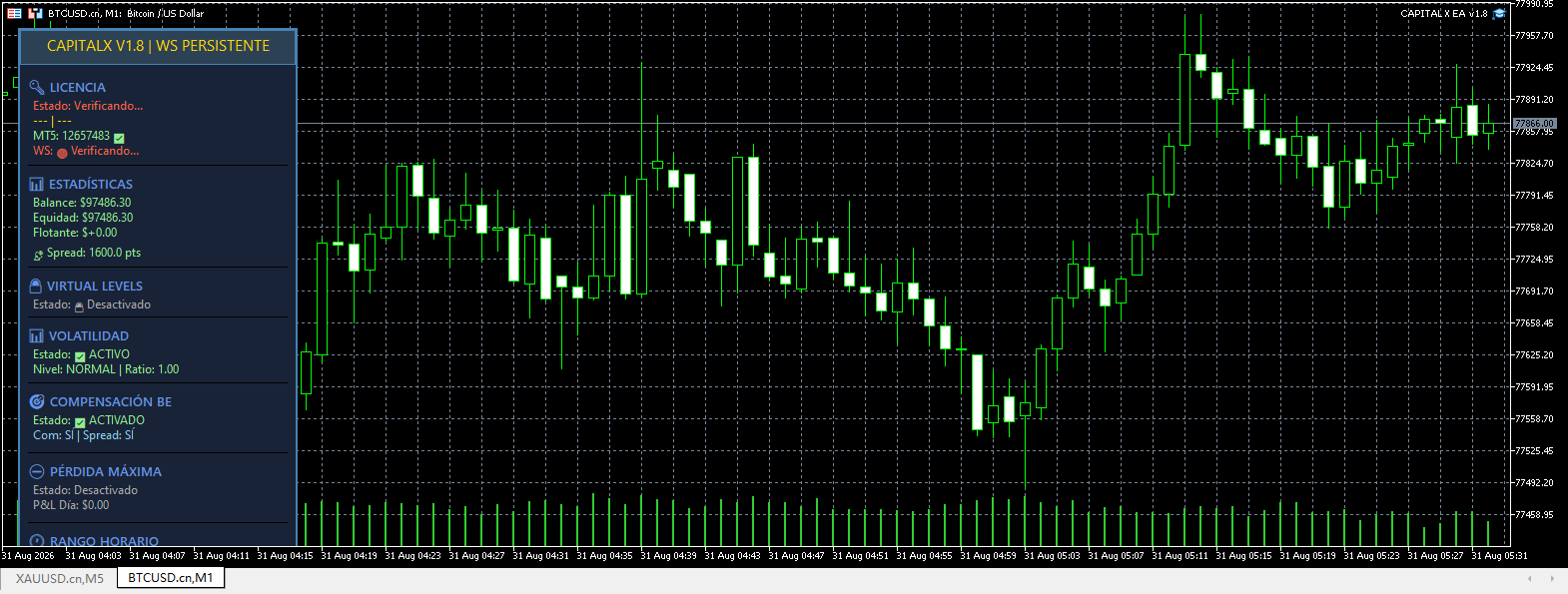
The entry filter is built around the Average True Range indicator. The EA classifies current conditions as low, normal, or high volatility. When volatility falls below a threshold, trading is suspended. This is not a simple on/off switch; the classification feeds into how far pending orders are placed from the market price, so the system adapts its entry distance to current conditions.
Execution uses pending orders that wait for a candle close to confirm direction before they are placed. Once filled, the position is managed in stages. The stop loss can be moved to break-even after a certain amount of profit, with the break-even level adjusted to cover spread and commission costs. A trailing stop then takes over to protect open profit. This layered management means the EA does not rely on a single exit condition.
Virtual stop loss and take profit support is included. When enabled, the actual stop and target levels are hidden from the broker and managed on the client side. This can be useful on accounts where the broker's execution does not allow tight stops on Bitcoin, though it also means the protection depends on the EA running without interruption.
Account and Broker Configuration
The stated minimum deposit is $1,000, and the developer notes that Cent accounts can be used effectively at that level. Leverage is listed as any, meaning the EA does not impose a specific requirement, but the account type should be ECN or Raw Spread. Lower-spread execution matters here because the break-even logic explicitly accounts for spread and commission costs. On a standard account with wider spreads, the break-even threshold would be later, which changes when protection activates.
Since the product is sold as a closed binary without source code, users cannot modify the logic. The NoDLL licence means no external DLL calls are required, which simplifies installation and reduces the chance of compatibility problems with restricted VPS environments. Traders who want to inspect or alter the code will need to look elsewhere.
Operational Considerations
The EA includes spread protection, which blocks entry when the spread exceeds a predefined limit. On Bitcoin, spreads can widen sharply during news or low-liquidity sessions, so this filter can prevent a mathematically valid entry from being executed at a bad price. The trade-off is that some potentially profitable entries will be skipped.
Daily profit and loss controls are built in. The EA can stop trading for the day once a profit target or loss limit is reached. This is a blunt tool, but it prevents a slow bleed or gives the account a chance to lock in a good day. The trading schedule can also be configured by day and session, so users can restrict activity to specific hours.
Finally, the system uses money management settings that the vendor describes as supporting both conservative and aggressive profiles. The specifics of how lot size is calculated are not documented in the product listing, so a trader should test different settings on a demo account before trusting the default behaviour with real funds.