Who This EA Fits
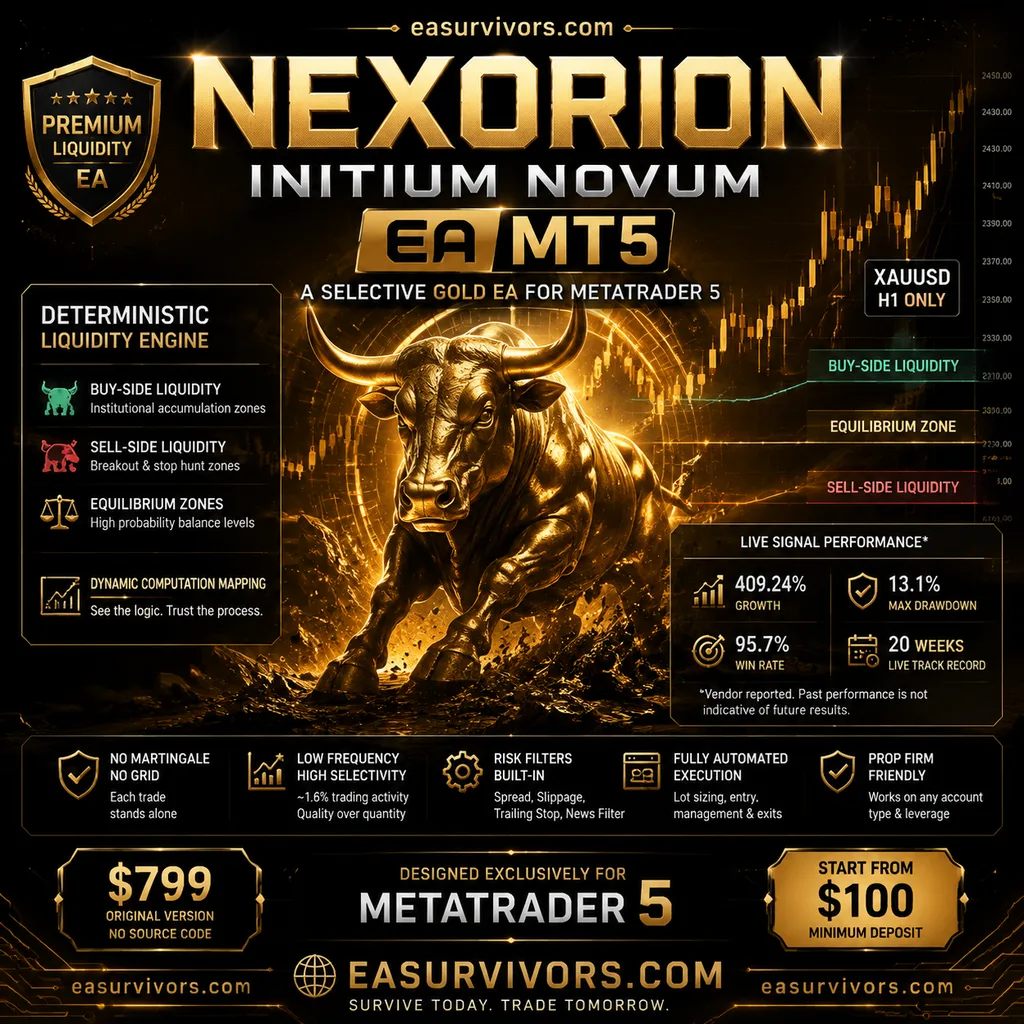
This system is built for traders who want a deliberately quiet gold strategy. It opens positions only when its own liquidity calculations align, so the user should expect long stretches without any trade. That profile fits professionals who trade XAUUSD intraday on H1 but prefer automation over manual execution, and it also suits prop-firm candidates who need a non-aggressive, rule-based approach. It is not for traders who want constant activity, scalping frequency, or a system that recovers losses by adding to positions.
Deterministic Liquidity Logic
Instead of standard indicators like moving averages or RSI, the EA reads market structure through liquidity concepts. It maps buy-side liquidity, sell-side liquidity, equilibrium zones, premium and discount pricing, and phase transitions. Every entry is based on a predefined mathematical evaluation of these zones rather than a subjective chart pattern. The developer calls this a deterministic liquidity engine because the same market data should produce the same structural interpretation every time.
Dynamic Computation Mapping
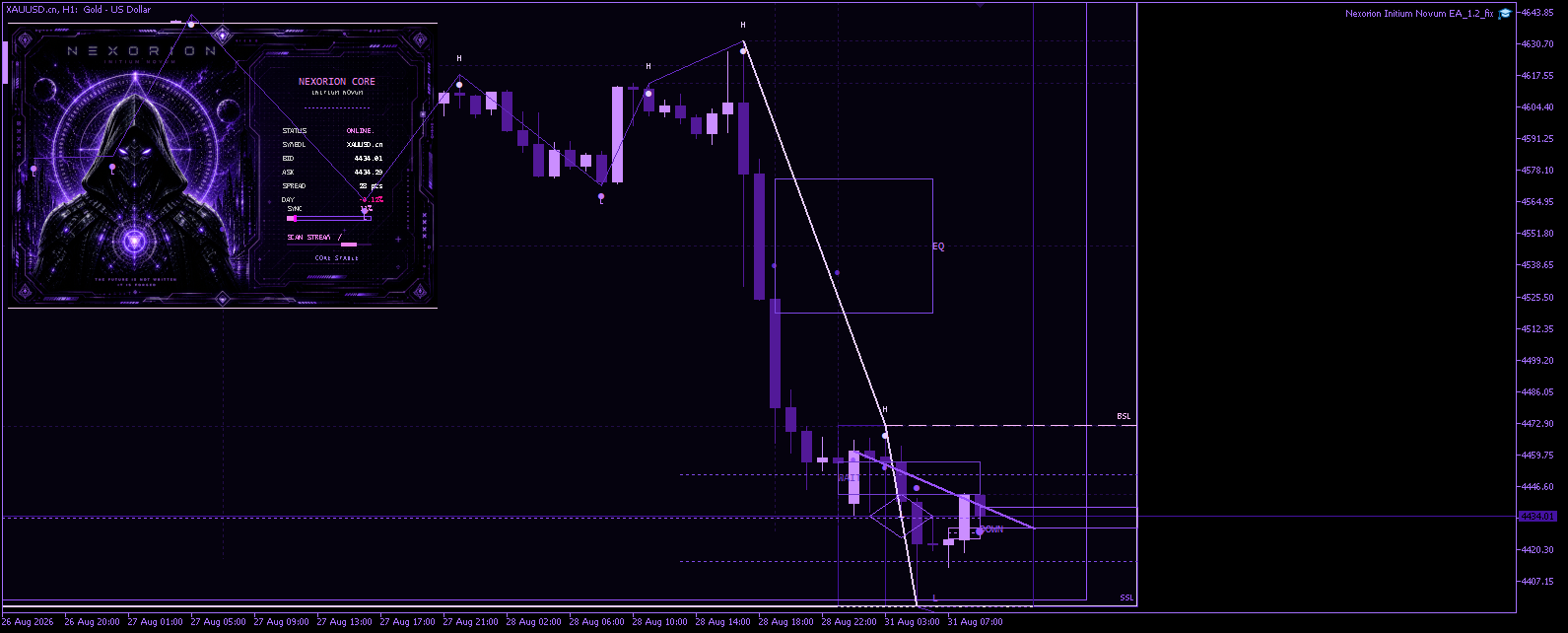
A distinctive part of this product is the on-chart visualisation. The EA plots the computed liquidity zones and equilibrium levels directly on the XAUUSD H1 chart. Traders can see exactly where the algorithm thinks institutional interest sits and how price is positioned relative to those areas. This makes the logic inspectable in real time, which is rare for a closed-source expert advisor.
Position Management and Risk Controls
Once a trade is placed, the EA handles execution details without manual input. It manages stop loss, take profit, a trailing stop, and lot sizing. The lot size can be set to automatic risk-based sizing or a fixed lot value. Spread and slippage filters are included, so if trading conditions degrade at the moment of a signal, the EA can refuse the trade. An economic news filter is also available to avoid entries around high-impact releases. The system explicitly does not use martingale, grid, or position averaging. Each trade is independent, with its own predefined risk.
Account Requirements and Broker Conditions
The product is engineered for MetaTrader 5 only. Gold trading on H1 does not demand ultra-low latency, but the developer recommends an ECN or STP account for tighter spreads and better execution. No minimum deposit is specified by the vendor. However, the reference live signal started with a $500 deposit, which may serve as a practical baseline. Traders should verify their broker's minimum lot size for XAUUSD and ensure it allows the EA's automatic lot-sizing calculations. Leverage and account type are not fixed by the software, but the spread and slippage filters will behave differently across brokers, and a high-spread account may cause the EA to skip trades.
Live Signal and Backtest Context
The developer has published a verified live signal that ran for approximately 20 weeks. According to the vendor, it grew from $500 to $2,784.11, with a maximum drawdown of 13.1% and a trading activity level of just 1.6%. That low activity confirms the selective nature of the system. The profit trade percentage reported is 95.7%. A separate backtest on XAUUSD H1 over 146 trades showed a net profit of $2,837.32 from a $500 deposit, a profit factor of 11.11, and a relative drawdown of 18.42%. These figures are vendor-reported and should be treated as descriptive, not as a promise of future results.
What to Watch Out For
The first thing to understand is trade frequency. A system that trades only 1.6% of the time will leave long idle periods. That is by design, but it can feel unproductive to a trader used to daily signals. The drawdown of 13-18% on a $500 account is moderate, but on a larger account the same percentage represents a larger absolute loss. The EA has no source code included, so users cannot inspect or modify the internal logic. All settings are adjusted via the input parameters. Finally, the backtest and live results come from the vendor's own published environment; independent verification on the user's broker and account type is necessary before judging performance.