What this expert advisor is designed to do
This is an automated breakout trading system built exclusively for spot gold on the MetaTrader 5 platform. Rather than trading a single chart, it operates across four timeframes simultaneously: M5, M15, M30, and H1. Each timeframe runs as a separate module with its own parameters for entry distance, stop loss, take profit, historical candle range, and breakout recalculation. The idea is to catch momentum when price pushes beyond a recent range, but with each timeframe contributing its own view of what a meaningful breakout looks like.
The vendor's marketing material emphasises precision and discipline. What that means in practice is that the EA recalculates pending entry levels as price moves, so orders are not left at stale levels. A spread filter blocks new positions when the broker's spread is above a user-defined threshold. Optional break-even protection and an ATR-based trailing stop can be switched on or off. Traders can also choose between a fixed lot size and a percentage-risk model, which adjusts position size based on account balance and stop loss distance.
Breakout logic across four timeframes
The central mechanism is the breakout detection. For each timeframe, the EA measures a historical candle range and sets an entry distance beyond that range. If price moves far enough, a pending order is triggered. The parameters are independent, so a trader could, for example, set a tighter breakout on M5 and a wider one on H1. This is not a single-model system; it is intentionally modular.
Dynamic recalculation addresses a known problem with static breakout levels. If the market trends slowly, a breakout level set hours ago may no longer be relevant. The EA updates its levels when predefined movement thresholds are reached, which means the orders track the market more closely. That does not guarantee better results, but it prevents the system from trading levels that no longer reflect current price structure.
The spread filter is worth highlighting. Gold spreads vary considerably depending on the broker and time of day. If the EA is set to skip trades when the spread is above, say, 30 points, it will simply not enter during illiquid periods. This can reduce the number of trades and also the average entry cost. It is a feature that experienced traders often look for in gold EAs, because spread can quickly eat into breakout profits.
Installation and configuration
The package includes set files alongside the EA file. Set files are pre-configured parameter groups that allow a user to load a specific setup without manually entering dozens of values. The vendor does not include source code, so the EA cannot be modified or recompiled. It will run only on MetaTrader 5, not MT4.
Configuration is done through the standard MT5 input panel. The key decisions are:
- Money management: fixed lot size or percentage of account risk.
- Timeframe enable/disable: turn each of the four modules on or off and set its own parameters.
- Spread filter: set a maximum spread in points.
- Trade management: enable or disable break-even, ATR trailing, and dynamic update intervals.
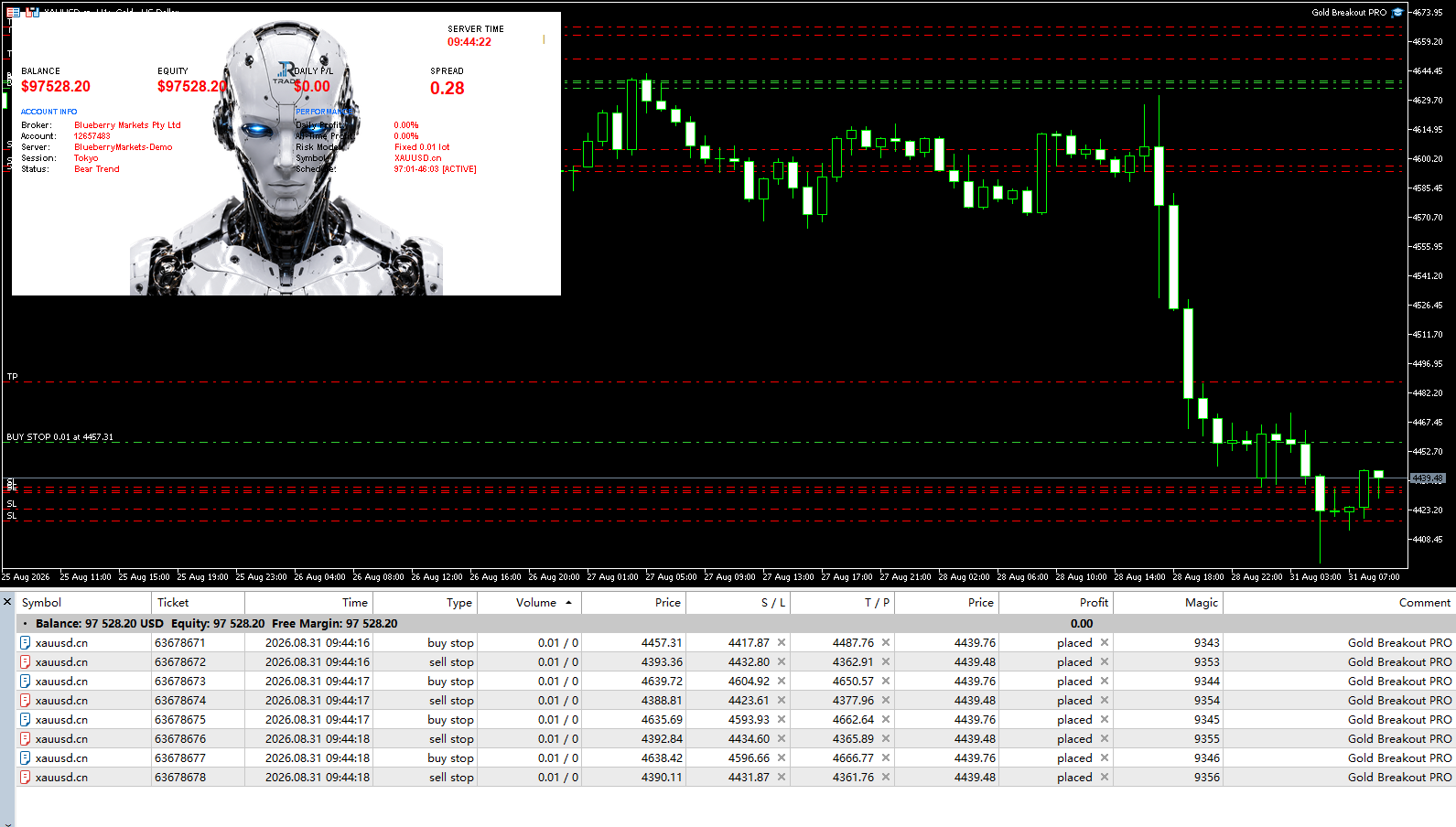
- Visual panel: a real-time on-chart display of trading information.
The visual panel shows current positions and key settings without needing to open the terminal's trade tab. It is a minor convenience but useful on a busy chart.
Performance optimisation is mentioned by the vendor. In practice this means logging controls can be switched off during strategy tester runs to speed up backtesting. It is not an automatic profit optimiser, despite the wording in the source material. Traders who run optimisations in MT5 will appreciate the reduced logging overhead, but it does not change the trading logic.
What the backtest shows and does not show
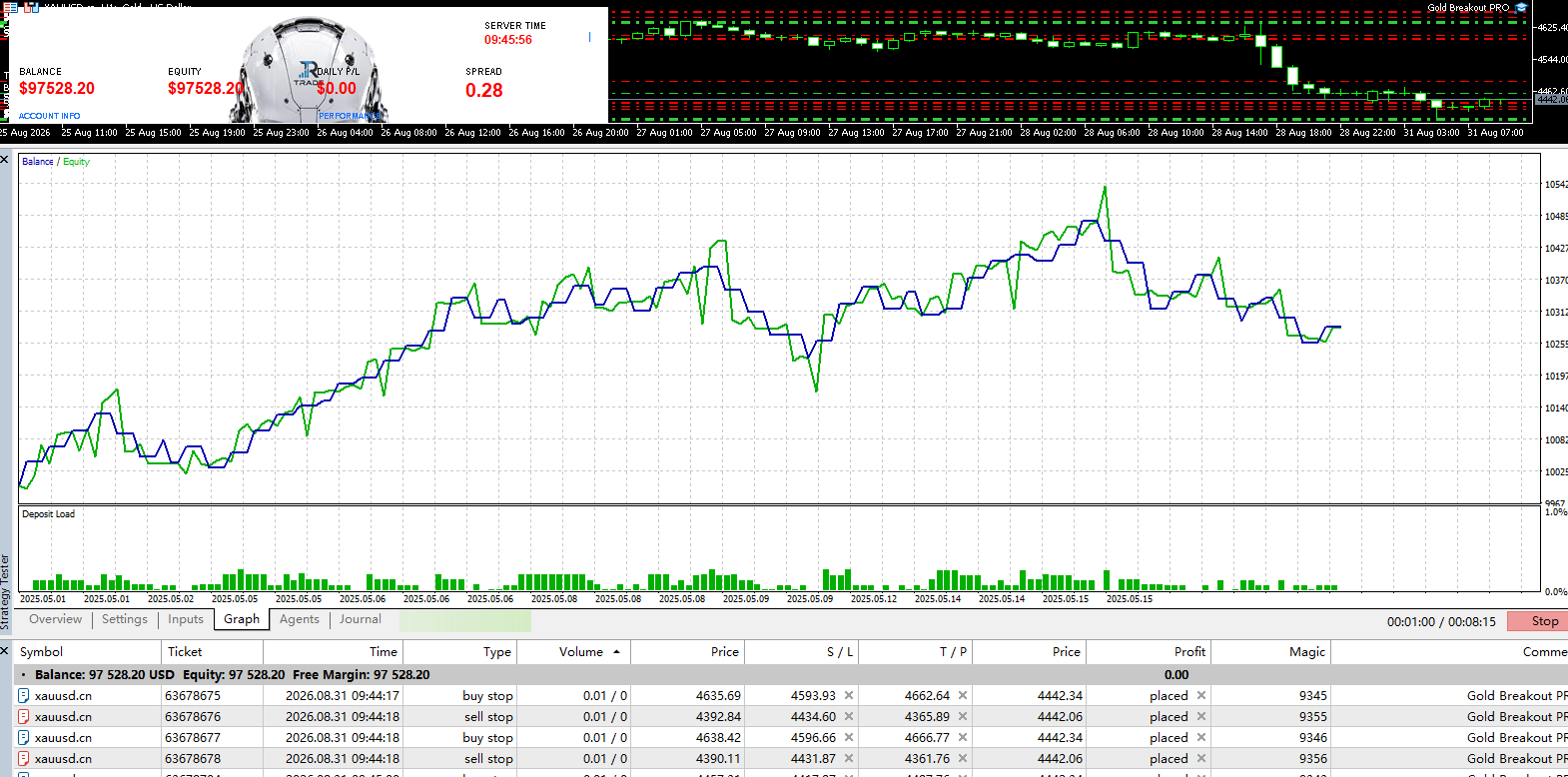
The vendor provides a six-month backtest from January to June 2026 on XAUUSD with a $1,000 initial deposit. The reported results are a total net profit of $4,307.21, a profit factor of 1.27, a win rate of 67.61%, and a relative drawdown of 25.87% over 1,235 trades. The developer states that these figures come from a historical simulation, not a live account.
A drawdown of over 25% on a $1,000 account means the equity dipped to roughly $750 at some point. For a trader using fixed lots on a small account, that is a significant level of risk. The profit factor of 1.27 is modest; it indicates that for every dollar lost, the system made $1.27. That is not an exceptional edge in gold trading, but it does suggest the system was not losing money over that specific six-month period.
Backtests should be treated as a demonstration of the logic under historical conditions, not as a predictor. Gold volatility changes, and the period shown may not be representative of what happens after purchase. The vendor does not publish live trading results in the source material.
Realistic expectations for gold breakout trading
An experienced trader looking at this product should ask what it offers beyond a simple breakout EA. The answer is the multi-timeframe structure and the dynamic recalculation. Most basic breakout EAs use a single timeframe and static levels. This one spreads its activity across four charts and shifts its levels as the market moves. Whether that produces better results depends on the market regime.
The spread filter and the option to use percentage-based risk management are sensible features for small accounts. But the drawdown reported in the backtest is a reminder that breakout systems on gold can suffer long losing streaks. A trader considering this EA should plan for drawdowns and not rely on the backtest's equity curve.
The lack of source code is standard for commercial EAs at this price point. Traders who want to modify the logic or inspect the code should be aware that they will not be able to do so. The EA is sold as a fixed product with set files for different configurations.
Ultimately, this is a breakout system for XAUUSD on MT5. It is not a martingale or grid strategy, and it does not rely on averaging down losing positions. It takes one trade per signal per timeframe, with defined stop loss and take profit levels. That structure may appeal to traders who want a rule-based approach to gold without watching four charts manually.